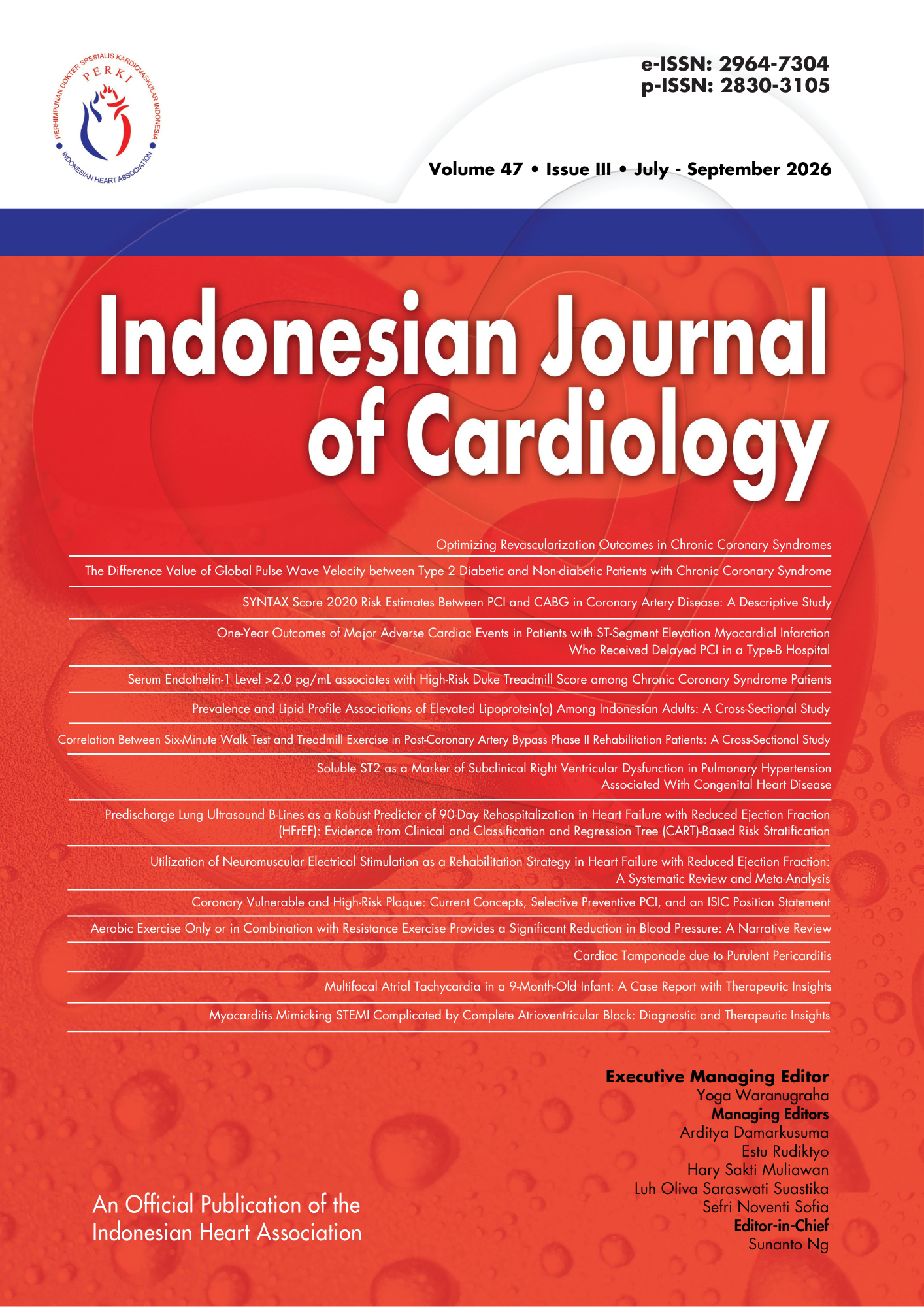
Correlation Between Six-Minute Walk Test and Treadmill Exercise in Post-Coronary Artery Bypass Phase II Rehabilitation Patients: A Cross-Sectional Study
Abstract
Background: Coronary Artery Bypass Grafting (CABG) improves survival in advanced Coronary Artery Disease (CAD) but is often associated with reduced functional capacity during recovery. Phase II cardiac rehabilitation improves physical performance, yet accessible and reliable tools are needed to monitor progress. Treadmill Cardiopulmonary Exercise Testing (CPET) is the gold standard for assessing aerobic capacity, but it is resource-intensive and not widely available in many settings. The Six-Minute Walk Test (6MWT) is a simple alternative, but its validity compared with treadmill testing in Indonesian post-CABG patients
remains underexplored
Methods: This cross-sectional study was conducted at the National General Hospital Dr. Cipto Mangunkusumo in Jakarta between May 2023 and October 2024. Post-CABG patients who completed an eight-week Phase II cardiac rehabilitation program, were clinically stable, and able to perform both assessments were included. Functional capacity was determined by estimated VO2Max from the 6MWT and directly measured VO2Max from a symptom-limited treadmill test using the Modified Bruce protocol. Descriptive statistics summarized baseline characteristics. Spearman correlation coefficient was used to evaluate the relationship
between the two tests, with statistical significance set at p<0.05.
Results: Fifteen post-CABG patients completed the study. Most were male (73.3%) with a mean age of 59 years. Overweight status was common (46.7%), with hypertension (80.0%), dyslipidemia (66.7%), and diabetes mellitus (53.3%) as frequent comorbidities. Mean 6MWT
distance increased from 307.8 ± 85.7 m pre-rehabilitation to 498.5 ± 140.7 m post-rehabilitation. The estimated VO2Max from the 6MWT followed a normal distribution and is reported as a mean of 18.9 mL/kg/min (SD = 4.2). In contrast, the treadmill-measured VO2
Max was nonnormally distributed and is therefore reported as a median of 21.4 mL/kg/min. A significant moderate positive correlation was found between 6MWT and treadmill VO2Max (r = 0.689, p = 0.005).
Conclusion: The 6MWT demonstrated a strong, significant correlation with treadmill-based VO2Max, supporting its use as a practical and cost-effective alternative for functional capacity assessment in post-CABG Phase II rehabilitation. Routine integration of the 6MWT may facilitate individualized exercise prescription and enhance patient monitoring, particularly in resource-limited settings.
Downloads
References
2. Saba MA, Goharpey S, Attarbashi Moghadam B, Salehi R, Nejatian M. Correlation Between the 6-Min Walk Test and Exercise Tolerance Test in Cardiac Rehabilitation After Coronary Artery Bypass Grafting: A Cross-sectional Study. Cardiology and Therapy.2021;10:201-209
3. Ambrosetti M, Abreu A, Corrà U, Davos CH, Hansen D, Frederix I, et al. Secondary prevention through comprehensive cardiovascular rehabilitation: From knowledge to implementation. 2020 update. A position paper from the Secondary Prevention and Rehabilitation Section of the European Association of Preventive Cardiology. European Journal of Preventive Cardiology.2021;28:460-495
4. Taylor JL, Myers J, Bonikowske AR. Practical guidelines for exercise prescription in patients with chronic heart failure. Heart Failure Reviews.2023;28:1285-1296
5. Oliveira MJ, Marçôa R, Moutinho J, Oliveira P, Ladeira I, Lima R, Guimarães M. Reference equations for the 6-minute walk distance in healthy Portuguese subjects 18–70 years old. Pulmonology.2019;25:83-89
6. Nusdwinuringtyas N. Six Minute Walking Distance Cut-off Point in Indonesian (Mongoloid) Population. Journal Of The Indonesian Medical Association.2018;68:389-394
7. Wu Y, Ren B, Li J, Chi L, Li P, Wu J. Physical performance on the early 6-minute walk test in coronary artery bypass grafting patients during inpatient cardiac rehabilitation. Frontiers in Cardiovascular Medicine.2025;12
8. Nevelikova M, Dosbaba F, Pepera G, Felsoci M, Batalikova K, Su JJ, Batalik L. Validity and reliability of automated treadmill six-minute walk test in patients entering exercise-based cardiac rehabilitation. Annals of Medicine.2023;55:2304664
9. Grewal J, McCully RB, Kane GC, Lam C, Pellikka PA. Left ventricular function and exercise capacity. JAMA.2009;301:286-294
10. Lim YC, Teo S-G, Poh K-K. ST-segment changes with exercise stress. Singapore Medical Journal.2016;57:347-353
11. Carvalho de Arruda Veiga E, Ferreira Levy R, Sales Bocalini D, Maria Soares Junior J, Chada Baracat E, Carvalho Cavalli R, dos Santos L. Exercise training and experimental myocardial ischemia and reperfusion: A systematic review and meta-analysis. International Journal of Cardiology. Heart & Vasculature.2023;46:101214
12. Sun H-J, Wu Z-Y, Nie X-W, Bian J-S. Role of Endothelial Dysfunction in Cardiovascular Diseases: The Link Between Inflammation and Hydrogen Sulfide. Frontiers in Pharmacology.2019;10:1568
13. Kosmas CE, Bousvarou MD, Kostara CE, Papakonstantinou EJ, Salamou E, Guzman E. Insulin resistance and cardiovascular disease. The Journal of International Medical Research.2023;51:03000605231164548
14. Chakraborty S, Verma A, Garg R, Singh J, Verma H. Cardiometabolic Risk Factors Associated With Type 2 Diabetes Mellitus: A Mechanistic Insight. Clinical Medicine Insights: Endocrinology and Diabetes.2023;16:11795514231220780
15. Matondang RAP. Pemulihan Denyut Jantung Paska Rehabilitasi Jantung Fase II Sebagai Prediktor Kematian dan Rehospitalisasi 3 Bulan pada Pasien Paska Bedah Pintas Arteri Koroner. 2020
16. Hubisz MM, van der Stouwe JG, Ziob M, Steiner S, Uzun N, Weibel S, Lesan V, Erni D, Meier-Ruge L, Rodriguez Cetina Biefer H, Dzemali O, Vontobel J, Niederseer D. A comparative analysis of open heart surgery and minimally invasive cardiac surgery in exercise-based cardiac rehabilitation. Journal of Cardiothoracic Surgery.2024;19:390
17. Matyal R, Qureshi NQ, Mufarrih SH, Sharkey A, Bose R, Chu LM, Liu DC, Senthilnathan V, Mahmood F, Khabbaz KR. Update: Gender differences in CABG outcomes-Have we bridged the gap? PloS One.2021;16:e0255170
18. Harik L, Perezgrovas-Olaria R, Jr Soletti G, Dimagli A, Alzghari T, An KR, Cancelli G, Gaudino M. Sex differences in coronary artery bypass graft surgery outcomes: a narrative review. Journal of Thoracic Disease.2023;15:5041-5054
19. Al-Mallah MH, Juraschek SP, Whelton S, Dardari ZA, Ehrman JK, Michos ED, Blumenthal RS, Nasir K, Qureshi WT, Brawner CA, Keteyian SJ, Blaha MJ. Sex Differences in Cardiorespiratory Fitness and All-Cause Mortality: The Henry Ford ExercIse Testing (FIT) Project. Mayo Clinic Proceedings.2016;91:755-762
20. Belzunce MA, Henckel J, Di Laura A, Horga LM, Hart AJ. Similarities and differences in skeletal muscle and body composition between sexes: an MRI study of recreational cyclists. BMJ Open Sport & Exercise Medicine.2023;9:e001672
21. Johnson AP, Parlow JL, Whitehead M, Xu J, Rohland S, Milne B. Body Mass Index, Outcomes, and Mortality Following Cardiac Surgery in Ontario, Canada. Journal of the American Heart Association.2015;4:e002140
22. Manoharan MP, Raja R, Jamil A, Csendes D, Gutlapalli SD, Prakash K, Swarnakari KM, Bai M, Desai DM, Desai A, Penumetcha SS. Obesity and Coronary Artery Disease: An Updated Systematic Review 2022. Cureus.2022;14:e29480
23. Gaalema DE, Savage PD, O’Neill S, Bolívar HA, Denkmann D, Priest JS, Khadanga S, Ades PA. The Association of Patient Educational Attainment With Cardiac Rehabilitation Adherence and Health Outcomes. Journal of Cardiopulmonary Rehabilitation and Prevention.2022;42:227-234
24. Hellsten Y, Nyberg M. Cardiovascular Adaptations to Exercise Training. Comprehensive Physiology.2015;6:1-32
25. Green DJ, Smith KJ. Effects of Exercise on Vascular Function, Structure, and Health in Humans. Cold Spring Harbor Perspectives in Medicine.2018;8:a029819
26. Hood DA, Memme JM, Oliveira AN, Triolo M. Maintenance of Skeletal Muscle Mitochondria in Health, Exercise, and Aging. Annual Review of Physiology.2019;81:19-41
27. Yang X, Li Y, Ren X, Xiong X, Wu L, Li J, Wang J, Gao Y, Shang H, Xing Y. Effects of exercise-based cardiac rehabilitation in patients after percutaneous coronary intervention: A meta-analysis of randomized controlled trials. Scientific Reports.2017;7:44789
28. Perry CGR, Hawley JA. Molecular Basis of Exercise-Induced Skeletal Muscle Mitochondrial Biogenesis: Historical Advances, Current Knowledge, and Future Challenges. Cold Spring Harbor Perspectives in Medicine.2018;8:a029686
29. Matos Casano HA, Ahmed I, Anjum F. Six-Minute Walk Test. In: StatPearls. StatPearls Publishing, Treasure Island (FL). 2025
30. Wicks JR, Turner GT, Leslie SL, Jayasinghe R. Changes Observed in the 6-minute Walk Test in Response to Exercise-based Cardiac Rehabilitation. Exercise Medicine.2022;6:2
31. Zanini M, Nery RM, de Lima JB, Buhler RP, da Silveira AD, Stein R. Effects of Different Rehabilitation Protocols in Inpatient Cardiac Rehabilitation After Coronary Artery Bypass Graft Surgery: A RANDOMIZED CLINICAL TRIAL. Journal of Cardiopulmonary Rehabilitation and Prevention.2019;39:E19-E25
32. Chae G, Ko EJ, Lee SW, Kim HJ, Kwak SG, Park D, Ra SW. Stronger correlation of peak oxygen uptake with distance of incremental shuttle walk test than 6-min walk test in patients with COPD: a systematic review and meta-analysis. BMC pulmonary medicine.2022;22:102
33. Jalili M, Nazem F, Sazvar A, Ranjbar K. Prediction of Maximal Oxygen Uptake by Six-Minute Walk Test and Body Mass Index in Healthy Boys. The Journal of Pediatrics.2018;200:155-159
34. Cavero-Redondo I, Saz-Lara A, Bizzozero-Peroni B, Núñez-Martínez L, Díaz-Goñi V, Calero-Paniagua I, Matínez-García I, Pascual-Morena C. Accuracy of the 6-Minute Walk Test for Assessing Functional Capacity in Patients With Heart Failure With Preserved Ejection Fraction and Other Chronic Cardiac Pathologies: Results of the ExIC-FEp Trial and a Meta-Analysis. Sports Medicine - Open.2024;10:74
PDF downloads: 104
Copyright (c) 2026 Indonesian Journal of Cardiology

This work is licensed under a Creative Commons Attribution 4.0 International License.
Authors who publish with this journal agree to the following terms:
- Authors retain copyright and grant the journal right of first publication with the work simultaneously licensed under a Creative Commons Attribution License that allows others to share the work with an acknowledgement of the work's authorship and initial publication in this journal.
- Authors are able to enter into separate, additional contractual arrangements for the non-exclusive distribution of the journal's published version of the work (e.g., post it to an institutional repository or publish it in a book), with an acknowledgement of its initial publication in this journal.
- Authors are permitted and encouraged to post their work online (e.g., in institutional repositories or on their website) prior to and during the submission process, as it can lead to productive exchanges, as well as earlier and greater citation of published work (See The Effect of Open Access).