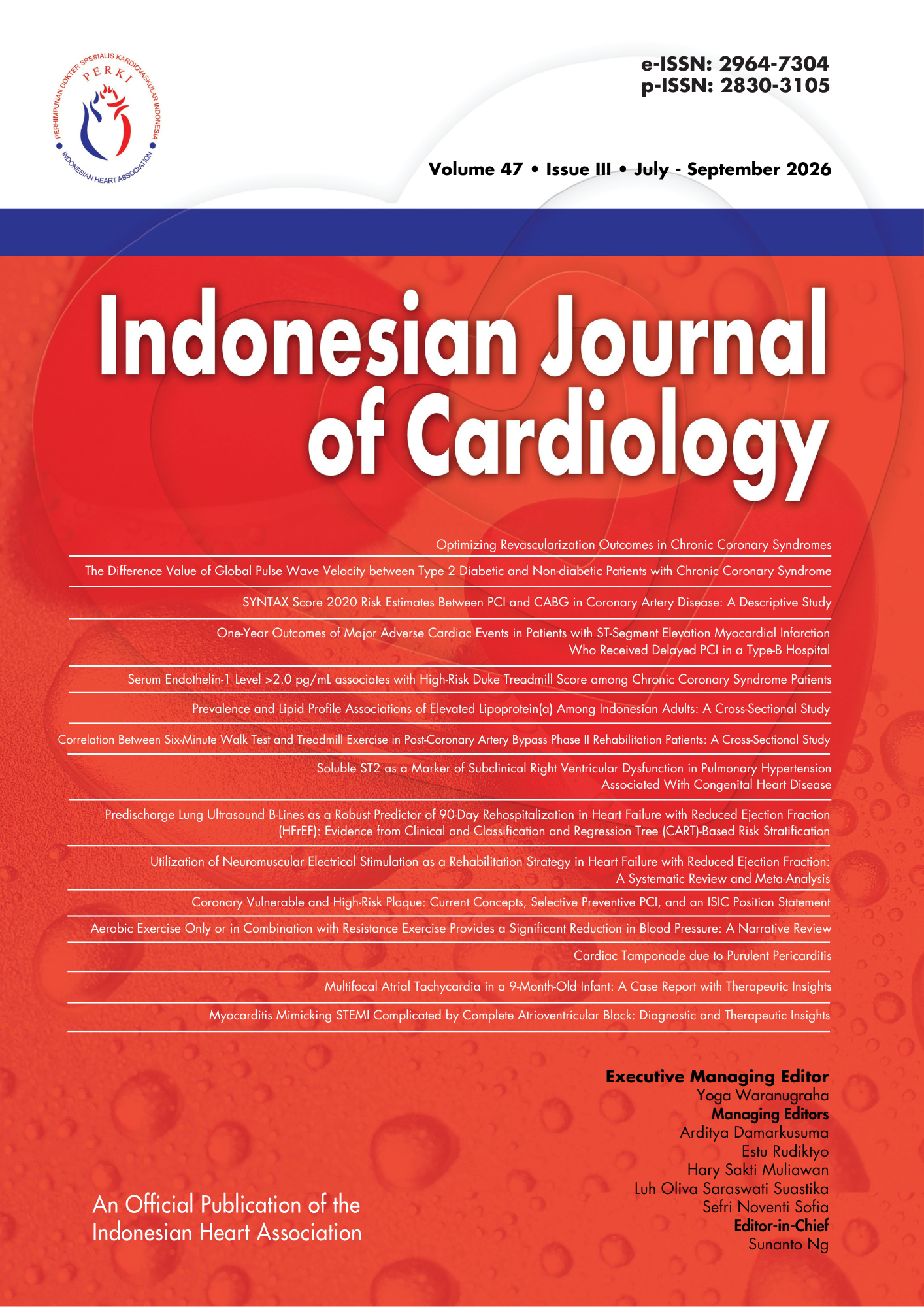
Utilization of Neuromuscular Electrical Stimulation as a Rehabilitation Treatment in Heart Failure with Reduced Ejection Fraction: A Systematic Review and Meta-Analysis
Abstract
Heart Failure with Reduced Ejection Fraction (HFrEF) is associated with substantial functional impairment, and many patients are unable to participate in conventional exercise-based cardiac rehabilitation. Neuromuscular Electrical Stimulation (NMES) has been proposed as an alternative rehabilitation treatment, but its clinical effectiveness remains uncertain. This review aims to evaluate the effectiveness of NMES in improving cardiac function and exercise capacity in patients with HFrEF. A systematic review and meta-analysis of Randomized Controlled Trials (RCTs) was conducted in accordance with Preferred Reporting Items for Systematic Reviews and Meta-Analyses (PRISMA) guidelines. Studies comparing NMES with standard medical therapy, exercise training, or no intervention in adult patients with HFrEF were identified through major electronic databases. Risk of bias was assessed using the Cochrane RoB 2.0 tool. Pooled effects were calculated as Mean Differences (MD) with 95% Confidence Intervals (CIs) using Review Manager (RevMan) version 5.4. Twelve RCTs involving 636 participants were included. NMES significantly improved peak oxygen uptake (VO2 peak) (MD 2.03 mL/kg/min; 95% CI 1.21 to 2.84; p < 0.00001), systolic blood pressure (MD −2.02; 95% CI −3.97 to −0.06; p = 0.04), Left Ventricular Ejection Fraction (LVEF) (MD −1.38%; 95% CI −2.73 to −0.03; p = 0.05), and Heart Rate (HR) (MD 2.19 beats/min; 95% CI 0.44 to 3.95; p = 0.01). A borderline significant improvement was observed in the Six-Minute Walk Test (6MWT) distance (MD −11.40 m; 95% CI −23.04 to 0.24; p = 0.05). No significant effects were found for diastolic blood pressure (MD −0.12; 95% CI −3.30 to 3.06; p = 0.94) or Minnesota Living with Heart Failure Questionnaire (MLHFQ) scores (MD 1.97; 95% CI −9.06 to 13.01; p = 0.73). NMES is associated with meaningful improvements in exercise capacity and selected parameters of cardiac function in patients with HFrEF, supporting its role as a potential adjunct rehabilitation treatment.
Downloads
References
2. Heidenreich PA, Bozkurt B, Aguilar D, et al. 2022 AHA/ACC/HFSA Guideline for the Management of Heart Failure: A Report of the American College of Cardiology/American Heart Association Joint Committee on Clinical Practice Guidelines. Vol 145.; 2022. doi:10.1161/CIR.0000000000001063
3. James SL, Abate D, Abate KH, et al. Global, regional, and national incidence, prevalence, and years lived with disability for 354 Diseases and Injuries for 195 countries and territories, 1990-2017: A systematic analysis for the Global Burden of Disease Study 2017. Lancet. 2018;392(10159):1789-1858. doi:10.1016/S0140-6736(18)32279-7
4. Murphy SP, Ibrahim NE, Januzzi JL. Heart Failure with Reduced Ejection Fraction: A Review. JAMA - J Am Med Assoc. 2020;324(5):488-504. doi:10.1001/jama.2020.10262
5. Jones NR, Roalfe AK, Adoki I, Hobbs FDR, Taylor CJ. Survival of patients with chronic heart failure in the community: a systematic review and meta-analysis. Eur J Heart Fail. 2019;21(11):1306-1325. doi:10.1002/ejhf.1594
6. Niklasson A, Maher J, Patil R, et al. Living with heart failure: patient experiences and implications for physical activity and daily living. ESC Hear Fail. 2022;9(2):1206-1215. doi:10.1002/ehf2.13795
7. Bozkurt B, Fonarow GC, Goldberg LR, et al. Cardiac Rehabilitation for Patients With Heart Failure: JACC Expert Panel. J Am Coll Cardiol. 2021;77(11):1454-1469. doi:10.1016/j.jacc.2021.01.030
8. Barriault A, Iftikhar U, Stone JA. Cardiac Rehabilitation and Heart Failure with Reduced Ejection Fraction: Pathophysiology, Benefits, and Precautions. Can J Cardiol. 2024;41(3):443-455. doi:10.1016/j.cjca.2024.10.014
9. Epelde F. Optimizing Cardiac Rehabilitation in Heart Failure: Comprehensive Insights, Barriers, and Future Strategies. Medicina. 2024; 60(10):1583.https://doi.org/10.3390/medicina60101583
10. Saitoh M, dos Santos MR, Anker M, Anker SD, von Haehling S, Springer J. Neuromuscular electrical stimulation for muscle wasting in heart failure patients. Int J Cardiol. 2016;225:200-205. doi:10.1016/j.ijcard.2016.09.127
11. Kondo T, Yamada S, Tanimura D, et al. Neuromuscular electrical stimulation is feasible in patients with acute heart failure. ESC Hear Fail. 2019;6(5):975-982. doi:10.1002/ehf2.12504
12. Poltavskaya M, Sviridenko V, Giverts I, et al. In-hospital electrical muscle stimulation for patients early after heart failure decompensation: Results from a prospective randomised controlled pilot trial. Open Hear. 2022;9(2):1-8. doi:10.1136/openhrt-2022-001965
13. Tanaka S, Kamiya K, Matsue Y, et al. Efficacy and Safety of Acute Phase Intensive Electrical Muscle Stimulation in Frail Older Patients with Acute Heart Failure: Results from the ACTIVE-EMS Trial. J Cardiovasc Dev Dis. 2022;9(4). doi:10.3390/jcdd9040099
14. Arenja N, Mueller C, Tomilovskaya E, Koryak Y, Poltavskaya M, Saner H. Real-world experience of feasibility and efficacy of electrical muscle stimulation in elderly patients with acute heart failure: A randomized controlled study. Int J Cardiol. 2021;344(July):113-119. doi:10.1016/j.ijcard.2021.09.062
15. Poltavskaya MG, Sviridenko VP, Kozlovskaya IB, et al. Comparison of the Efficacy of Neuromuscular Electrostimulation and Interval Exercise Training in Early Rehabilitation of Patients Hospitalized with Decompensation of Chronic Heart Failure. Hum Physiol. 2018;44(6):663-672. doi:10.1134/S0362119718060087
16. Ennis S, McGregor G, Hamborg T, et al. Randomised feasibility trial into the effects of low-frequency electrical muscle stimulation in advanced heart failure patients. BMJ Open. 2017;7(8):1-8. doi:10.1136/bmjopen-2017-016148
17. Forestieri P, Bolzan DW, Santos VB, et al. Neuromuscular electrical stimulation improves exercise tolerance in patients with advanced heart failure on continuous intravenous inotropic support use—randomized controlled trial. Clin Rehabil. 2018;32(1):66-74. doi:10.1177/0269215517715762
18. Iliou MC, Vergès-Patois B, Pavy B, et al. Effects of combined exercise training and electromyostimulation treatments in chronic heart failure: A prospective multicentre study. Eur J Prev Cardiol. 2017;24(12):1274-1282. doi:10.1177/2047487317712601
19. Kadoglou NPE, Mandila C, Karavidas A, et al. Effect of functional electrical stimulation on cardiovascular outcomes in patients with chronic heart failure. Eur J Prev Cardiol. 2017;24(8):833-839. doi:10.1177/2047487316687428
20. Sacilotto MCB, Lavagnoli CFR, Silveira-Filho LM, et al. A Simpler and Shorter Neuromuscular Electrical Stimulation Protocol Improves Functional Status and Modulates Inflammatory Profile in Patients with End-Stage Congestive Heart Failure. Int J Cardiovasc Sci. 2017;30(6):484-495. doi:10.5935/2359-4802.20170064
21. Groehs R V., Antunes-Correa LM, Nobre TS, et al. Muscle electrical stimulation improves neurovascular control and exercise tolerance in hospitalised advanced heart failure patients. Eur J Prev Cardiol. 2016;23(15):1599-1608. doi:10.1177/2047487316654025
22. Parissis J, Karavidas A, Farmakis D, et al. Efficacy and safety of functional electrical stimulation of lower limb muscles in elderly patients with chronic heart failure: A pilot study. Eur J Prev Cardiol. 2015;22(7):831-836. doi:10.1177/2047487314540546
23. Soska V, Dobsak P, Pohanka M, et al. Exercise training combined with electromyostimulation in the rehabilitation of patients with chronic heart failure: A randomized trial. Biomed Pap. 2014;158(1):98-106. doi:10.5507/bp.2012.096
24. Méndez‐Fernández A, Fernández‐Mora Á, Bernal‐Ramírez J, et al. Distinguishing pathophysiological features of heart failure with reduced and preserved ejection fraction: A comparative analysis of two mouse models. J Physiol. 2024;0:1-17. doi:10.1113/jp286410
25. Schwinger RHG. Pathophysiology of heart failure. Cardiovasc Diagn Ther. 2021;11(1):263-276. doi:10.21037/CDT-20-302
26. Blazevich AJ, Collins DF, Millet GY, Vaz MA, Maffiuletti NA. Enhancing Adaptations to Neuromuscular Electrical Stimulation Training Interventions. Exerc Sport Sci Rev. 2021;49(4):244-252. doi:10.1249/JES.0000000000000264
27. Rl P, Ac N, Turcu D, Bn M, Sc S, Berteanu M. Effects of neuromuscular electrical stimulation in patients with heart failure - review Heart failure and oxidative stress. J Med Life. 2018;11(2):107-118. https://www.ncbi.nlm.nih.gov/pmc/articles/PMC6101682/pdf/JMedLife-11-107.pdf
28. Kucio C, Stastny P, Leszczyńska-Bolewska B, et al. Exercise‐based cardiac rehabilitation with and without neuromuscular electrical stimulation and its effect on exercise tolerance and life quality of persons with chronic heart failure. J Hum Kinet. 2018;65(1):151-164. doi:10.2478/hukin-2018-0045.
PDF downloads: 114
Copyright (c) 2026 Indonesian Journal of Cardiology

This work is licensed under a Creative Commons Attribution 4.0 International License.
Authors who publish with this journal agree to the following terms:
- Authors retain copyright and grant the journal right of first publication with the work simultaneously licensed under a Creative Commons Attribution License that allows others to share the work with an acknowledgement of the work's authorship and initial publication in this journal.
- Authors are able to enter into separate, additional contractual arrangements for the non-exclusive distribution of the journal's published version of the work (e.g., post it to an institutional repository or publish it in a book), with an acknowledgement of its initial publication in this journal.
- Authors are permitted and encouraged to post their work online (e.g., in institutional repositories or on their website) prior to and during the submission process, as it can lead to productive exchanges, as well as earlier and greater citation of published work (See The Effect of Open Access).