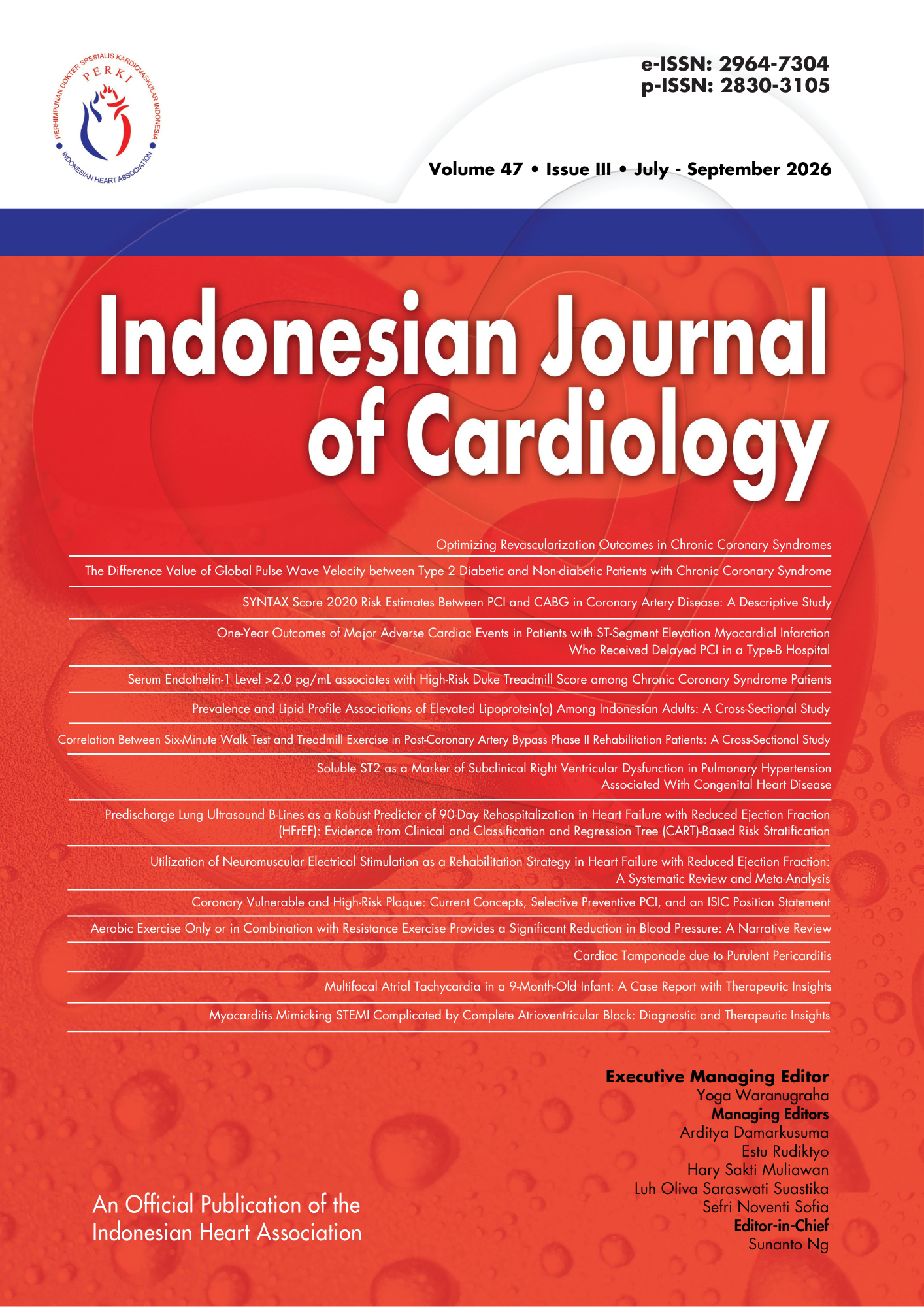
SYNTAX Score 2020 Risk Estimates Between PCI and CABG in Coronary Artery Disease : A Descriptive Study
Abstract
Background:
The SYNTAX Score 2020 is a validated tool that combines anatomical and clinical parameters to estimate long-term outcomes in CAD and guide revascularization decisions between PCI and CABG. Although its components are well defined, further studies are needed to clarify how clinical variables influence risk predictions in diverse populations, including Indonesia.
Methods:
This cross-sectional study enrolled 115 patients with angiographically confirmed CAD at dr. Doris Sylvanus Regional General Hospital, Palangka Raya, Indonesia, between January and June 2025. The SYNTAX Score 2020 and anatomical SYNTAX Score I were calculated using the official application. Statistical analyses included bivariate non-parametric tests, Spearman correlations, and multivariate linear regression to identify independent clinical determinants of the SYNTAX Score 2020–predicted 10-year mortality and 5-year MACE following PCI and CABG.
Results:
PVD and DM were strongly associated with a higher SYNTAX Score 2020–predicted 5-year MACE and 10-year mortality after both PCI and CABG, with a stepwise increase in risk from no DM to insulin-treated DM. LMCAD was associated with a higher CABG-predicted risk than 3VD, whereas smoking was not associated with predicted outcomes. Age and SYNTAX Score I were positively correlated with all risk estimates, whereas CrCl and LVEF were inversely correlated. In the multivariate models, age, PVD, DM, and lower LVEF remained independent predictors for both strategies; SYNTAX Score I remained significant only for PCI, and CrCl was no longer independently associated with risk.
Conclusion:
Age was the main independent predictor of a higher SYNTAX Score 2020 that predicted long-term risk, followed by PVD and diabetes (highest in insulin-treated DM). Higher LVEF was protective, and left main disease carried a higher predicted risk than three-vessel disease.
Downloads
References
2. Lawton JS, Tamis-Holland JE, Bangalore S, Bates ER, Beckie TM, Bischoff JM, et al. 2021 ACC/AHA/SCAI guideline for coronary artery revascularization. J Am Coll Cardiol. 2022;79(2):e21–e129. doi:10.1016/j.jacc.2021.09.005.
3. Neumann FJ, Sousa-Uva M, Ahlsson A, Alfonso F, Banning AP, Benedetto U, et al. 2018 ESC/EACTS guidelines on myocardial revascularization. Eur Heart J. 2019;40(2):87–165. doi:10.1093/eurheartj/ehy394.
4. Takahashi K, Serruys PW, Fuster V, Farkouh ME, Spertus JA, Cohen DJ, et al. Redevelopment and validation of the SYNTAX score II to individualise decision making between percutaneous and surgical revascularisation in patients with complex coronary artery disease. Lancet. 2020;396(10260):1399–1412. doi:10.1016/S0140-6736(20)32114-0.
5. Hara H, Shiomi H, van Klaveren D, Kent DM, Steyerberg EW, Garg S, et al. External validation of the SYNTAX Score II 2020. J Am Coll Cardiol. 2021;78(12):1227–1238. doi:10.1016/j.jacc.2021.07.027.
6. American Diabetes Association Professional Practice Committee. Classification and diagnosis of diabetes: Standards of medical care in diabetes—2023. Diabetes Care. 2023;46(Suppl 1):S19–S40. doi:10.2337/dc23-S002.
7. Mazzolai L, Teixidó-Tura G, Lanzi S, Boc V, Bossone E, Brodmann M, et al.; ESC Scientific Document Group. 2024 ESC guidelines for the management of peripheral arterial and aortic diseases. Eur Heart J. 2024;45(36):3538–3700. doi:10.1093/eurheartj/ehae179.
8. Sahajanand Medical Technologies Pvt Ltd. SYNTAX Score 2020 [mobile application]. Version 1.3.3. Pune (IN): Sahajanand Medical Technologies Pvt Ltd; 2020. Accessed 7 Nov 2025.
9. Ford TJ, Corcoran D, Berry C. Stable coronary syndromes: pathophysiology, diagnostic advances and therapeutic need. Heart. 2018;104:284–292.
10. Knuuti J, Wijns W, Saraste A, Capodanno D, Barbato E, Funck-Brentano C, et al. 2019 ESC guidelines for the diagnosis and management of chronic coronary syndromes. Eur Heart J. 2020;41(3):407–477. doi:10.1093/eurheartj/ehz425.
11. Li X, Xiao F, Zhang S. Coronary revascularisation in patients with chronic kidney disease and end-stage renal disease: a meta-analysis. Int J Clin Pract. 2021;75:e14506.
12. Grazioli V, et al. Myocardial revascularization in patients with chronic kidney disease: CABG versus PCI. Interact Cardiovasc Thorac Surg. 2025;40(3):ivaf021.
13. Tam DY, Dharma C, Rocha RV, Austin PC, Wijeysundera HC, Farkouh ME, et al. Long-term survival after surgical or percutaneous revascularization in patients with diabetes and multivessel coronary disease. J Am Coll Cardiol. 2020;76:1153–1164.
14. Tam DY, Dharma C, Rocha RV, et al. Revascularization strategies for the treatment of multivessel coronary artery disease in patients with diabetes mellitus. Circ Cardiovasc Interv. 2020;13(9):e009082.
15. Aboul-Hassan SS, et al. Impact of incomplete revascularization on long-term survival based on revascularization strategy. Ann Thorac Surg. 2024.
16. Kim T, Kang DY, Kim S, et al. Impact of complete or incomplete revascularization for left main coronary disease: the extended PRECOMBAT study. JACC Asia. 2023;3(1):65–74. doi:10.1016/j.jacasi.2022.10.007.
17. Higashi Y, et al. Smoking cessation and vascular endothelial function. Hypertens Res. 2023;46(12):2670–2678. doi:10.1038/s41440-023-01455-z.
18. Jia X, et al. Tobacco use and endothelial function: a meta-analysis. BMC Cardiovasc Disord. 2024;24:391. doi:10.1186/s12872-024-03915-x.
19. Polman R, Hurst JR, Uysal OF, Mandal S, Linz D, Simons S. Cardiovascular disease and risk in COPD: a state-of-the-art review. Expert Rev Respir Med. 2024;18(4):317–329. doi:10.1080/17476348.2024.2333786.
20. Heffernan M, Rutherford S. The intersection of COPD and cardiovascular disease. Cardiopulm Care Rev. 2025; article in press. doi:10.1016/j.cjco.2025.01.001.
PDF downloads: 125
Copyright (c) 2026 Indonesian Journal of Cardiology

This work is licensed under a Creative Commons Attribution 4.0 International License.
Authors who publish with this journal agree to the following terms:
- Authors retain copyright and grant the journal right of first publication with the work simultaneously licensed under a Creative Commons Attribution License that allows others to share the work with an acknowledgement of the work's authorship and initial publication in this journal.
- Authors are able to enter into separate, additional contractual arrangements for the non-exclusive distribution of the journal's published version of the work (e.g., post it to an institutional repository or publish it in a book), with an acknowledgement of its initial publication in this journal.
- Authors are permitted and encouraged to post their work online (e.g., in institutional repositories or on their website) prior to and during the submission process, as it can lead to productive exchanges, as well as earlier and greater citation of published work (See The Effect of Open Access).