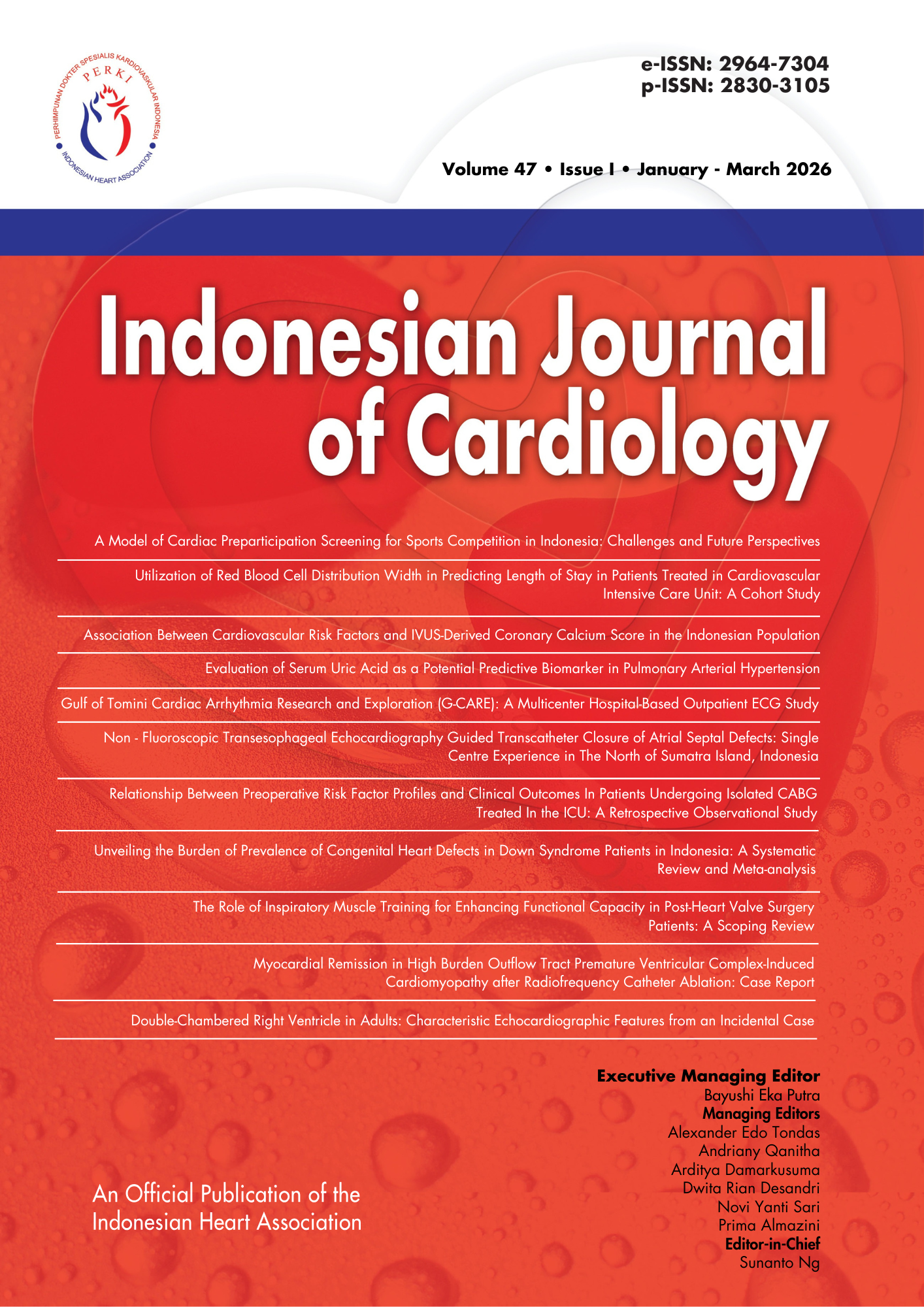
Evaluation of Serum Uric Acid as a Potential Predictive Biomarker in Pulmonary Arterial Hypertension
Abstract
Background: Pulmonary arterial hypertension (PAH) is a relatively rare fatal disease, confounding many cardiopulmonary diseases. Systolic pulmonary artery pressure (sPAP), measured by transthoracic echocardiography, can be taken as a surrogate marker for diagnosing this disease. Uric acid, a marker of oxidative stress, has been investigated as a potential predictive biomarker for risk stratification. Our study was conducted to ascertain the incidence and severity of sPAP, to evaluate the level of uric acid levels, and to establish a correlation.
Methods: This is an observational case-control study that included 51 cases of PAH diagnosed by sPAP ≥36 mm Hg, along with 51 controls. Serum uric acid was assayed using a spectrophotometric method. Statistical analysis was performed using Microsoft Excel and SPSS version 20.0.
Results: Cases were observed in the range of 24 to 87 years (average 48 years) with female predominance. Uric acid levels were significantly higher in cases than in controls. Females showed slightly lower levels of uric acid as compared to males. Correlation analysis indicated a significant positive correlation between sPAP and uric acid levels. Receiver operating characteristic (ROC) analysis demonstrated that serum uric acid had 68% predictive accuracy for sPAP severity at a cutoff of 5.45 mg/dL.
Conclusion: The level of uric acid, a routine biomarker analysed in laboratories, is found to be increased in PAH patients and closely correlates with the severity of sPAP. This suggests a potential role of uric acid as a predictive biomarker in PAH management.
Downloads
References
2. Bousseau S, Fais RS, Gu S, Frump A, Lahm T. Pathophysiology and new advances in pulmonary hypertension. BMJ Medicine [Internet]. 2023 Mar 1;2(1). Available from: https://bmjmedicine.bmj.com/content/2/1/e000137
3. Galiè N, McLaughlin VV, Rubin LJ, Simonneau G. An overview of the 6th World Symposium on Pulmonary Hypertension. European Respiratory Journal [Internet]. 2019 Jan;53(1):1802148. Available from: http://www.wsphassociation.org/wp-content/uploads/2019/04/WSPH-Nice-2018-proceedings-compressed.pdf
4. Anand Reddy Maligireddy, Shore S, Kumar A, S. Harikrishnan, S. Ajit Mullasari, Sastry BKS, et al. Current status and barriers in pulmonary hypertension care delivery in India: A qualitative analysis. Pulmonary circulation. 2022 Apr 1;12(2).
5. Bossone E, D’Andrea A, D’Alto M, Citro R, Argiento P, Ferrara F, et al. Echocardiography in Pulmonary Arterial Hypertension: from Diagnosis to Prognosis. Journal of the American Society of Echocardiography [Internet]. 2013 Jan [cited 2019 Dec 15];26(1):1–14. Available from: https://www.asecho.org/wp-content/uploads/2014/09/33-2013-J-Am-Soc-Echocardiogr-Echocardiography-in-Pulmonary-Arterial-Hypertension.pdf
6. Maron BA. Revised Definition of Pulmonary Hypertension and Approach to Management: A Clinical Primer. Journal of the American Heart Association. 2023 Apr 18;12(8).
7. Hojda SE, Chis IC, Clichici S. Biomarkers in Pulmonary Arterial Hypertension. Diagnostics. 2022 Dec 3;12(12):3033.
8. Smits AJ, Botros L, Mol MAE, Ziesemer KA, Wilkins MR, Vonk Noordegraaf A, et al. A systematic review with meta-analysis of biomarkers for detection of pulmonary arterial hypertension. ERJ open research [Internet]. 2022 Apr 1 [cited 2024 Mar 15];8(2):00009-2022. Available from: https://pubmed.ncbi.nlm.nih.gov/35651362/
9. Nagaya N, Uematsu M, Satoh T, Kyotani S, Sakamaki F, Nakanishi N, et al. Serum uric acid levels correlate with the severity and the mortality of primary pulmonary hypertension. American Journal of Respiratory and Critical Care Medicine [Internet]. 1999 Aug 1 [cited 2024 Mar 15];160(2):487–92. Available from: https://pubmed.ncbi.nlm.nih.gov/10430718/
10. Zhou Y, Chen M, Zheng J, Shui X, He Y, Luo H, et al. Insights into the relationship between serum uric acid and pulmonary hypertension (Review). Molecular medicine reports [Internet]. 2024;29(1):10. Available from: https://www.ncbi.nlm.nih.gov/pmc/articles/PMC10704563/
11. Yan L, Huang Z, Zhao Z, Zhao Q, Tang Y, Zhang Y, et al. The Prognostic Impact of Serum Uric Acid on Disease Severity and 5-Year Mortality in Patients With Idiopathic Pulmonary Artery Hypertension. Frontiers in Medicine [Internet]. 2022 [cited 2024 Mar 15];9:805415. Available from: https://pubmed.ncbi.nlm.nih.gov/35155496/
12. Luo J, Li Y, Chen J, Qiu H, Chen W, Luo X, et al. Evaluating the role of serum uric acid in the risk stratification and therapeutic response of patients with pulmonary arterial hypertension associated with congenital heart disease (PAH-CHD). Frontiers in Pharmacology [Internet]. 2023 [cited 2024 Mar 15];14:1238581. Available from: https://pubmed.ncbi.nlm.nih.gov/37701027/
13. M. Hoeper M, Ghofrani HA, Grünig E, Klose H, Olschewski H, Rosenkranz S. Pulmonary Hypertension. DeutschesÄrzteblatt International [Internet]. 2017 Feb 1;114(5):73–84. Available from: https://www.ncbi.nlm.nih.gov/pmc/articles/PMC5331483/
14. Leber L, Beaudet A, Muller A. Epidemiology of pulmonary arterial hypertension and chronic thromboembolic pulmonary hypertension: identification of the most accurate estimates from a systematic literature review. Pulmonary Circulation. 2021 Jan;11(1):1–12.
15. Pasalic D, Marinkovic N, Feher-Turkovic L. Uric acid as one of the important factors in multifactorial disorders – facts and controversies. Biochemia Medica [Internet]. 2012 [cited 2020 Jan 24];63–75. Available from: https://www.ncbi.nlm.nih.gov/pmc/articles/PMC4062324/
16. Wang J, Wang Y, Li X, Huang Y, Sun X, Wang Q, et al. Serum uric acid is associated with disease severity and may predict clinical outcome in patients of pulmonary arterial hypertension secondary to connective tissue disease in Chinese: a single-center retrospective study. BMC pulmonary medicine. 2020 Oct 19;20(1).
17. Simpson CE, Damico RL, Hummers L, Khair RM, Kolb TM, Hassoun PM, et al. Serum uric acid as a marker of disease risk, severity, and survival in systemic sclerosis-related pulmonary arterial hypertension. Pulmonary Circulation [Internet]. 2019 [cited 2024 May 6];9(3):2045894019859477. Available from: https://pubmed.ncbi.nlm.nih.gov/31384431/
18. Aghdashi M, Behnemoon M, Mahmoodi Rad J, Rabiepour M. Evaluation of serum uric acid level in systemic lupus erythematosus patients with normal and high pulmonary arterial hypertension. BioMedicine. 2018 Aug 24;8(3):16.
19. Watanabe T, Ishikawa M, Abe K, Ishikawa T, Imakiire S, Masaki K, et al. Increased Lung Uric Acid Deteriorates Pulmonary Arterial Hypertension. Journal of the American Heart Association. 2021 Dec 7;10(23).
20. Li Q, Qiu Y, Han W, Zheng Y, Wang X, Xiao D, et al. Determination of uric acid in biological samples by high performance liquid chromatography-electrospray ionization-tandem mass spectrometry and study on pathogenesis of pulmonary arterial hypertension in pulmonary artery endothelium cells. RSC Advances [Internet]. 2018 [cited 2023 Apr 15];8(45):25808–14. Available from: https://pubs.rsc.org/en/content/articlehtml/2018/ra/c7ra12702b
21. Savale L, Akagi S, Tu L, Cumont A, Thuillet R, Phan C, et al. Serum and pulmonary uric acid in pulmonary arterial hypertension. The European Respiratory Journal [Internet]. 2021 Aug 1 [cited 2024 May 6];58(2):2000332. Available from: https://pubmed.ncbi.nlm.nih.gov/33446602/
22. Du P, Gao X, Sun Q, Gong M, Pan Y, Guo Q, et al. Association between uric acid and cardiac outcomes mediated by neutrophil-to-lymphocyte ratio in patients with left ventricular diastolic dysfunction and pulmonary hypertension. Scientific Reports [Internet]. 2024 Feb 2 [cited 2024 May 6];14(1):2751. Available from: https://pubmed.ncbi.nlm.nih.gov/38302600/
23. Li WT, Wu CW, Liu JM. Association of changes in NT-proBNP, hsTnT and uric acid levels with haemodynamic changes after targeted medical therapies in patients with idiopathic pulmonary arterial hypertension. Cardiovascular Journal of Africa [Internet]. 2022 [cited 2024 May 6];33(1):10–4. Available from: https://pubmed.ncbi.nlm.nih.gov/34851353/
PDF downloads: 479
Copyright (c) 2026 Indonesian Journal of Cardiology

This work is licensed under a Creative Commons Attribution 4.0 International License.
Authors who publish with this journal agree to the following terms:
- Authors retain copyright and grant the journal right of first publication with the work simultaneously licensed under a Creative Commons Attribution License that allows others to share the work with an acknowledgement of the work's authorship and initial publication in this journal.
- Authors are able to enter into separate, additional contractual arrangements for the non-exclusive distribution of the journal's published version of the work (e.g., post it to an institutional repository or publish it in a book), with an acknowledgement of its initial publication in this journal.
- Authors are permitted and encouraged to post their work online (e.g., in institutional repositories or on their website) prior to and during the submission process, as it can lead to productive exchanges, as well as earlier and greater citation of published work (See The Effect of Open Access).