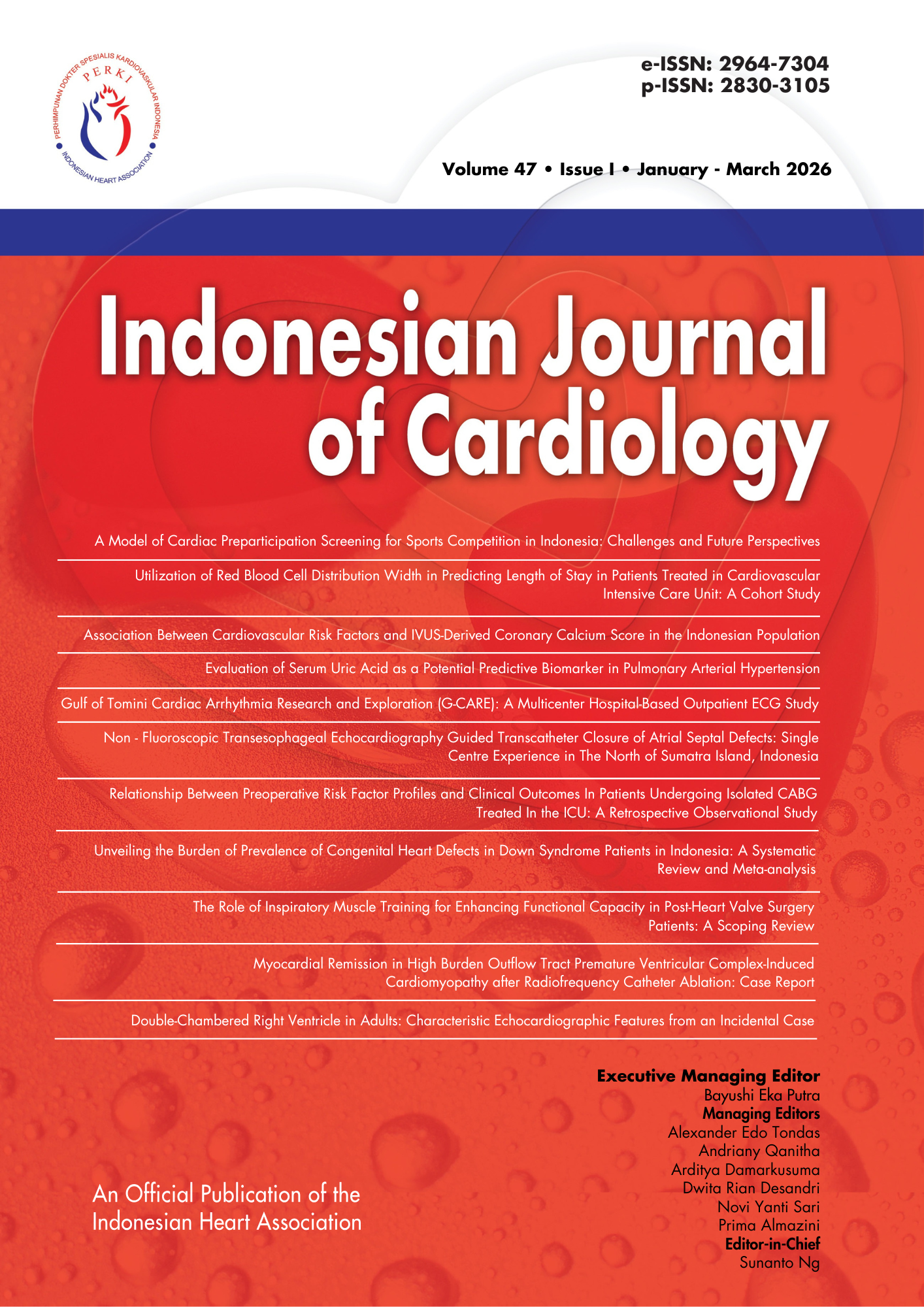
Non - Fluoroscopic Transesophageal Echocardiography Guided Transcatheter Closure of Atrial Septal Defects: Single Centre Experience in The North of Sumatra Island, Indonesia
Abstract
Background: Non-fluoroscopic, transesophageal-guided percutaneous closure of Atrial Septal Defect (ASD) can be a first-line strategy to reduce radiation exposure and its cumulative effects. We report our experience as the first center located far from the capital city of Indonesia that routinely performs transcatheter closure of ASD under the guidance of Transesophageal Echocardiography (TEE) without fluoroscopy.
Methods: We collected data of patients whose ASD was successfully closed percutaneously from May 2020 to August 2024. For a total of 116 patients of secundum ASD that are suitable for device closure, we routinely intend to do non-fluoroscopy transcatheter ASD closure guided by TEE.
Results: The zero-fluoroscopy technique was successfully performed in 111 patients. The ASD diameter is 10-40 mm, and the mean size of the occluding device is 9-42 mm. The mean procedural times are 55.81 ± 22.7 minutes. The success rate is 95% with only one case of pericardial effusion. Five cases were excluded as they were finally assisted by fluoroscopy due to the limitation of the echocardiographic view.
Conclusion: A thorough transcatheter ASD closure technique guided by TEE can routinely be performed without fluoroscopy.
Downloads
References
2. Ackermann S, Quandt D, Hagenbuch N, Niesse O, Christmann M, Knirsch W, Kretschmar O. Transcatheter atrial septal defect closure in children with and without fluoroscopy: a comparison. Journal of interventional cardiology. 2019;2019(1):6598637.
3. Prakoso R, Ariani R, Lilyasari O, Kurniawati Y, Siagian SN, Sakidjan I, Roebiono PS, Rahajoe AU, Lelya O, Sembiring AA, Harimurti GM. Percutaneous atrial septal defect closure using transesophageal echocardiography without fluoroscopy in a pregnant woman: a case report. Medical Journal of Indonesia. 2020 Jun 30;29(2):228â-32.
4. Yang Y, Zhang W, Wu Q, Gao L, Jin W, Zhao T. Transcatheter closure of atrial septal defects without fluoroscopy: a well-established procedure for alternative use in children. EuroIntervention. 2016 Aug 5;12(5):e652-7.
5. Helmut Baumgartner, Julie De Backer, Sonya V Babu-Narayan, Werner Budts, Massimo Chessa, Gerhard-Paul Diller, Bernard lung, Jolanda Kluin, Irene M Lang, Folkert Meijboom, Philip Moons, Barbara J M Mulder, Erwin Oechslin, Jolien W Roos-Hesselink, Markus Schwerzmann, Lars Sondergaard, Katja Zeppenfeld, ESC Scientific Document Group , 2020 ESC Guidelines for the management of adult congenital heart disease: The Task Force for the management of adult congenital heart disease of the European Society of Cardiology (ESC). Endorsed by: Association for European Paediatric and Congenital Cardiology (AEPC), International Society for Adult Congenital Heart Disease (ISACHD), European Heart Journal, Volume 42, Issue 6, 7 February 2021, Pages 563–645, https://doi.org/10.1093/eurheartj/ehaa554
6. Perhimpunan Dokter Spesialis Kardiovaskular Indonesia. Panduan Tatalaksana Penyakit Jantung Bawaan Dewasa (PJBD) 2020. Edisi Pertama. Jakarta: Perhimpunan Dokter Spesialis Kardiovaskular Indonesia; 2020
7. Jung SY, Choi JY. Transcatheter closure of atrial septal defect: principles and available devices. Journal of thoracic disease. 2018 Sep;10(Suppl 24):S2909.
8. Sisca Natalia Siagian, Kevin Moses Hanky Tandayu Jr, Putri Reno, Brian Mendel, Christianto Christianto, Radityo Prakoso. Echocardiography-guided percutaneous closure of oval-shaped secundum atrial septal defects. BMC Cardiovascular Disorders (2024) 24:534
9. Yuxiang Tang, Aijin Xie, Fengwen Zhang, Jie Dong, Chuangshi Wang, Xiangbin Pan, Percutaneous and Non-fluoroscopic Procedure for Atrial Septal Defect Closure, Patent Foramen Ovale Closure and Transcatheter Edge-to-edge Repair, Journal of Asian Pacific Society of Cardiology 2025;4:e34. https://doi.org/10.15420/japsc.2025.21
10. Tuzcu V, Michel-Behnke I, Schranz D. Transcatheter closure of atrial septal defects: Experience of a pediatric heart center. Eur J Gen Med. 2004 Jul 15;1(3):33-6.
11. Fraisse A, Latchman M, Sharma SR, Bayburt S, Amedro P, Di Salvo G, Baruteau AE. Atrial septal defect closure: indications and contra-indications. Journal of thoracic disease. 2018 Sep;10(Suppl 24):S2874.
12. Fathoni E, Martini H, Rahimah AF, Putri VY. Managing a Challenge Case: Transesophageal Echocardiography-Guided Transcatheter Closure of a Large Secundum Atrial Septal Defect in a Pregnant Woman. Heart Science Journal. 2024 Apr 28;5(2):67-71.
13. Xu WZ, Shou XY, Li JH, Yu JG, Zhang ZW, Yu J, Ye JJ. Non-fluoroscopic percutaneous transcatheter closure of atrial septal defects in children under transesophageal echocardiographic guidance. World Journal of Pediatrics. 2018 Aug;14:378-82.
14. Nassif M, Abdelghani M, Bouma BJ, Straver B, Blom NA, Koch KT, Tijssen JG, Mulder BJ, de Winter RJ. Historical developments of atrial septal defect closure devices: what we learn from the past. Expert review of medical devices. 2016 Jun 2;13(6):555-68.
15. Rodrigo Estévez-Loureiro, Isaac Martínez-Bendayan, Jorge Salgado-Fernández and Fernando Rueda-Núñez. Cobra-Like Deformation of Amplatzer Devices Used for Closing Atrial Septal Defects: Can It Be Avoided?.Rev Esp Cardiol. 2010;63(4):488-502
16. Kilic T, Ural E, Sahin T. Cobrahead Deformity in the Right Atrial Disc of a New-Generation Occlutech Figulla Flex II Atrial Septal Defect Occluder Device. Tex Heart Inst J. 2015 Oct 1;42(5):454-7. doi: 10.14503/THIJ-14-4179. PMID: 26504440; PMCID: PMC4591886.
17. Akita Rukmana Akbar,Valerinna Yogibuana. Approaches to closure of very large atrial septal defects in older adults: Challenges, complexities, and technical strategies. Heart ScienceJournal 2025; 6(3): 143-146
PDF downloads: 369
Copyright (c) 2026 Indonesian Journal of Cardiology

This work is licensed under a Creative Commons Attribution 4.0 International License.
Authors who publish with this journal agree to the following terms:
- Authors retain copyright and grant the journal right of first publication with the work simultaneously licensed under a Creative Commons Attribution License that allows others to share the work with an acknowledgement of the work's authorship and initial publication in this journal.
- Authors are able to enter into separate, additional contractual arrangements for the non-exclusive distribution of the journal's published version of the work (e.g., post it to an institutional repository or publish it in a book), with an acknowledgement of its initial publication in this journal.
- Authors are permitted and encouraged to post their work online (e.g., in institutional repositories or on their website) prior to and during the submission process, as it can lead to productive exchanges, as well as earlier and greater citation of published work (See The Effect of Open Access).