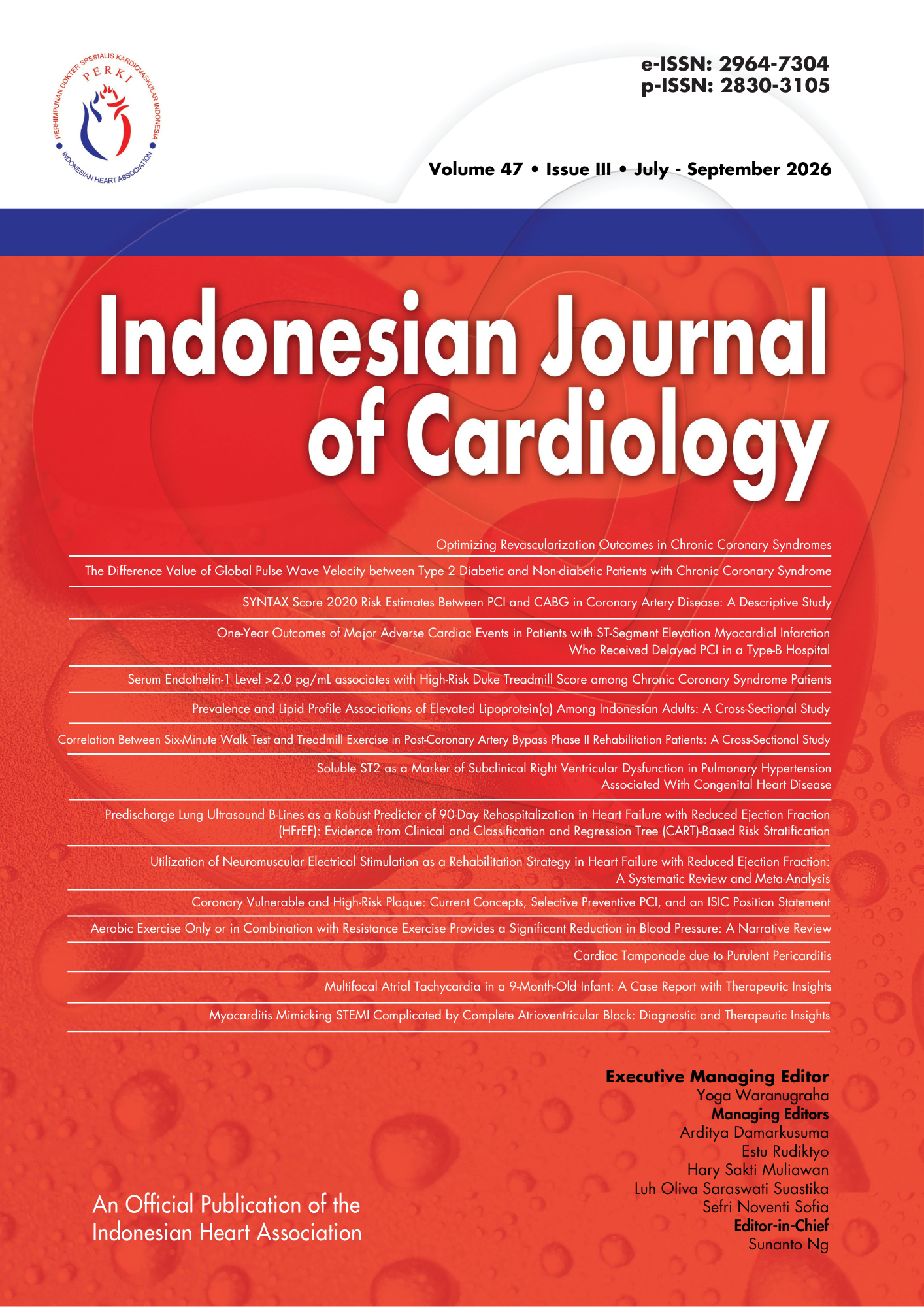
Optimizing Revascularization Outcomes in Chronic Coronary Syndromes
DOI:
https://doi.org/10.30701/ijc.2430Keywords:
Chronic Coronary Syndrome, Interventional CardiologyAbstract
The value of coronary revascularization in Chronic Coronary Syndromes (CCS) depends on whether it delivers the benefit that justifies intervention. Anatomical, physiological, and plaque assessment inform patient selection, but each answers a different clinical question. Applying evolving trial evidence requires attention to the populations studied, outcomes measured, and durability of treatment. Procedural optimization and complete revascularization require the same clinical judgment, with imaging and devices serving defined treatment goals. Medical therapy remains essential regardless of the revascularization strategy. Follow-up connects the procedure to sustained prevention, rehabilitation, and assessment of symptoms and clinical events. Reviewing these outcomes against the original indication, together with the patient’s priorities, provides a practical basis for improving care.
Downloads
References
2. Lawton JS, Tamis-Holland JE, Bangalore S, et al. 2021 ACC/AHA/SCAI Guideline for Coronary Artery Revascularization: A Report of the American College of Cardiology/American Heart Association Joint Committee on Clinical Practice Guidelines. J Am Coll Cardiol. 2022;79:e21–e129. doi:10.1016/j.jacc.2021.09.006.
3. Hochman JS, Anthopolos R, Reynolds HR, et al. Survival After Invasive or Conservative Management of Stable Coronary Disease. Circulation. 2023;147:8–19. doi:10.1161/CIRCULATIONAHA.122.062714.
4. Rajkumar CA, Foley MJ, Ahmed-Jushuf F, et al. A Placebo-Controlled Trial of Percutaneous Coronary Intervention for Stable Angina. N Engl J Med. 2023;389:2319–30. doi:10.1056/NEJMoa2310610.
5. Khan S, Sajjad U, Fawaz S, et al. Randomized, Placebo-Controlled Trial of Chronic Total Occlusion Percutaneous Coronary Intervention in Stable Angina: The ORBITA-CTO Trial. J Am Coll Cardiol. 2026;88:4–18. doi:10.1016/j.jacc.2026.03.027.
6. Fearon WF, Jeremias A, Witberg G, et al. Angiography-Derived Fractional Flow Reserve to Guide PCI. N Engl J Med. 2026;395:9–19. doi:10.1056/NEJMoa2600949.
7. Daemen J, van der Eijk JA, Barbierato M, et al. Angiography-Based Physiology to Guide Coronary Revascularization. N Engl J Med. 2026;395:20–31. doi:10.1056/NEJMoa2601841.
8. Weir-McCall JR, Koweek L, Suchá D, et al. Fractional flow reserve in coronary computed tomography angiography: An expert consensus document of the Society of Cardiovascular Computed Tomography (SCCT) and the Society for Cardiovascular Angiography and Interventions (SCAI). Endorsed by the American College of Cardiology (ACC). J Cardiovasc Comput Tomogr. 2026;20:316–32. doi:10.1016/j.jcct.2026.05.006.
9. Mizukami T, Ikeda K, Munhoz D, et al. Influence of Pullback Pressure Gradient on Residual Angina at One Year. Circ Cardiovasc Interv. 2026;19:e015851. doi:10.1161/CIRCINTERVENTIONS.125.015851.
10. Park SJ, Ahn JM, Kang DY, et al. Preventive percutaneous coronary intervention versus optimal medical therapy alone for the treatment of vulnerable atherosclerotic coronary plaques (PREVENT): a multicentre, open-label, randomised controlled trial. Lancet. 2024;403:1753–1765. doi:10.1016/S0140-6736(24)00413-6.
11. Waksman R, Di Mario C, Torguson R, et al. Identification of patients and plaques vulnerable to future coronary events with near-infrared spectroscopy intravascular ultrasound imaging: a prospective, cohort study. Lancet. 2019;394:1629–37. doi:10.1016/S0140-6736(19)31794-5.
12. Stone GW, Maehara A, Ali ZA, et al. Percutaneous Coronary Intervention for Vulnerable Coronary Atherosclerotic Plaque. J Am Coll Cardiol. 2020;76:2289–301. doi:10.1016/j.jacc.2020.09.547.
13. Fearon WF, Zimmermann FM, Ding VY, et al. Outcomes after fractional flow reserve-guided percutaneous coronary intervention versus coronary artery bypass grafting (FAME 3): 5-year follow-up of a multicentre, open-label, randomised trial. Lancet. 2025;405:1481–90. doi:10.1016/S0140-6736(25)00505-7.
14. Holck EN, Holm NR, Hildick-Smith D, et al. Percutaneous coronary intervention versus coronary artery bypass grafting for unprotected left main stenosis: 10-year final results from the randomised, open-label, non-inferiority NOBLE trial. Lancet. 2026;407:1374–82. doi:10.1016/S0140-6736(26)00205-9.
15. Lee JM, Kim O, Song YB, et al. Intravascular Imaging- vs Angiography-Guided Complex PCI: 5-Year Outcomes From a Randomized Trial. J Am Coll Cardiol. 2026;87:2099–113. doi:10.1016/j.jacc.2026.01.035.
16. Testa L, De la Torre Hernandez JM, De Maria GL, et al. IVUS-Guided versus Angiography-Guided PCI in Unprotected Left Main Coronary Disease. N Engl J Med. 2026;394:2189–99. doi:10.1056/NEJMoa2600440.
17. Diletti R, Daemen J, Faurie B, et al. Intravascular Ultrasound–Guided or Angiography-Guided Complex High-Risk PCI. N Engl J Med. 2026;394:2200–11. doi:10.1056/NEJMoa2601521.
18. Panuccio G, Abdelwahed YS, Tartaglione G, et al. Intravascular imaging-guided percutaneous coronary intervention for calcified coronary lesions: a network meta-analysis. JACC Adv. 2026;5:103237. doi:10.1016/j.jacadv.2026.103237.
19. Johnson TW, Gonzalo N, de la Torre Hernandez JM, et al. Intracoronary imaging for left main percutaneous coronary intervention: a clinical consensus statement of the European Association of Percutaneous Cardiovascular Interventions (EAPCI) of the ESC and the European Bifurcation Club (EBC). Eur Heart J. Published online May 15, 2026. doi:10.1093/eurheartj/ehag353.
20. Spaulding C, Krackhardt F, Bogaerts K, et al. Sirolimus-Eluting Balloon With Provisional Stenting Versus Systematic Drug-Eluting Stent Implantation to Treat De Novo Coronary Lesions: A Randomized, Open-Label, Noninferiority Trial. Circulation. 2026;154:185–97. doi:10.1161/CIRCULATIONAHA.126.079033.
21. Tao L, He X, Shen G, et al. Drug-Coated Balloon Angioplasty vs Up-Front Stenting for De Novo CAD: 3-Year Follow-Up of REC-CAGEFREE I Trial. J Am Coll Cardiol. 2026;87:312–29. doi:10.1016/j.jacc.2025.10.027.
22. Saboe A, Rasyid YJ, Wahyudi DP, Yahya AF, Garcia Garcia HM. One-year clinical outcomes after drug-coated balloon-only angioplasty for de novo lesions in non-small coronary vessels. Cardiovasc Revasc Med. Published online July 13, 2026. doi:10.1016/j.carrev.2026.07.007.
23. Saboe A, Yahya AF, Wahyudi DP, et al. One-year outcomes after hybrid DES-DCB and two-stent strategies for true distal left main bifurcation lesions: A single-center registry. Cardiovasc Revasc Med. 2026. doi:10.1016/j.carrev.2026.09.006.
24. Gao R, Song L, Fu G, et al. Sirolimus-Eluting Iron Bioresorbable Scaffolds vs Everolimus-Eluting Stents for Percutaneous Coronary Intervention: A Randomized Trial (IRONMAN II). J Am Coll Cardiol. 2026;87:2117–30. doi:10.1016/j.jacc.2025.12.024.
25. Otsuki H, Takahashi K, Kobayashi Y, et al. Completeness of revascularization in coronary three-vessel disease and outcomes in the FAME 3 trial. Eur Heart J. Published online August 31, 2026:ehag630. doi:10.1093/eurheartj/ehag630.
26. Byrne RA, Rossello X, Coughlan JJ, et al. 2023 ESC Guidelines for the management of acute coronary syndromes. Eur Heart J. 2023;44:3720–826. doi:10.1093/eurheartj/ehad191.
27. Mach F, Koskinas KC, Roeters van Lennep JE, et al. 2025 Focused Update of the 2019 ESC/EAS Guidelines for the management of dyslipidaemias. Eur Heart J. 2025;46:4359–78. doi:10.1093/eurheartj/ehaf190.
28. Ambari AM, Hasan H, Dwiputra B, et al. Indonesia-INTERASPIRE study: an Indonesian cross-sectional multicenter survey on cardiovascular secondary prevention in coronary heart disease. Med J Indones. 2025;34:158–66. doi:10.13181/mji.oa.257833.
29. Bergmark BA, Bohula EA, Marston NA, et al. Evolocumab in Patients With Prior Percutaneous Coronary Intervention and No Prior Myocardial Infarction: Results From the VESALIUS-CV Trial. Circulation. 2026;154:28–36. doi:10.1161/CIRCULATIONAHA.126.080616.
30. Saboe A, Rubio P, Sanz-Sánchez J, Sorolla Romero JA, Waksman R, Garcia-Garcia HM. Treatment effect of lipid-lowering strategy measured by intracoronary near-infrared spectroscopy (NIRS)-derived lipid core burden index (LCBI): A systematic review and meta-analysis. Cardiovasc Revasc Med. Published online July 14, 2026. doi:10.1016/j.carrev.2026.07.010.
31. Kang J, Park S, Yang HM, et al. Aspirin versus clopidogrel for chronic maintenance monotherapy after percutaneous coronary intervention: 10-year follow-up of the HOST-EXAM trial. Lancet. 2026;407:1439–47. doi:10.1016/S0140-6736(26)00422-8.
32. Bäck M, Wilhelm M, Marcin T, et al. 2026 ESC Guidelines on cardiac rehabilitation. Eur Heart J. Published online August 28, 2026. doi:10.1093/eurheartj/ehag099.
33. Dakota I, Muharram FR, Multazam CECZ, et al. Modelling the coverage gap in percutaneous coronary intervention in LMIC: a geospatial analysis of cath lab coverage in Indonesia. Open Heart. 2026;13:e003702. doi:10.1136/openhrt-2025-003702.
Downloads
Published
How to Cite
Issue
Section
License
Authors who publish with this journal agree to the following terms:
- Authors retain copyright and grant the journal right of first publication with the work simultaneously licensed under a Creative Commons Attribution License that allows others to share the work with an acknowledgement of the work's authorship and initial publication in this journal.
- Authors are able to enter into separate, additional contractual arrangements for the non-exclusive distribution of the journal's published version of the work (e.g., post it to an institutional repository or publish it in a book), with an acknowledgement of its initial publication in this journal.
- Authors are permitted and encouraged to post their work online (e.g., in institutional repositories or on their website) prior to and during the submission process, as it can lead to productive exchanges, as well as earlier and greater citation of published work (See The Effect of Open Access).