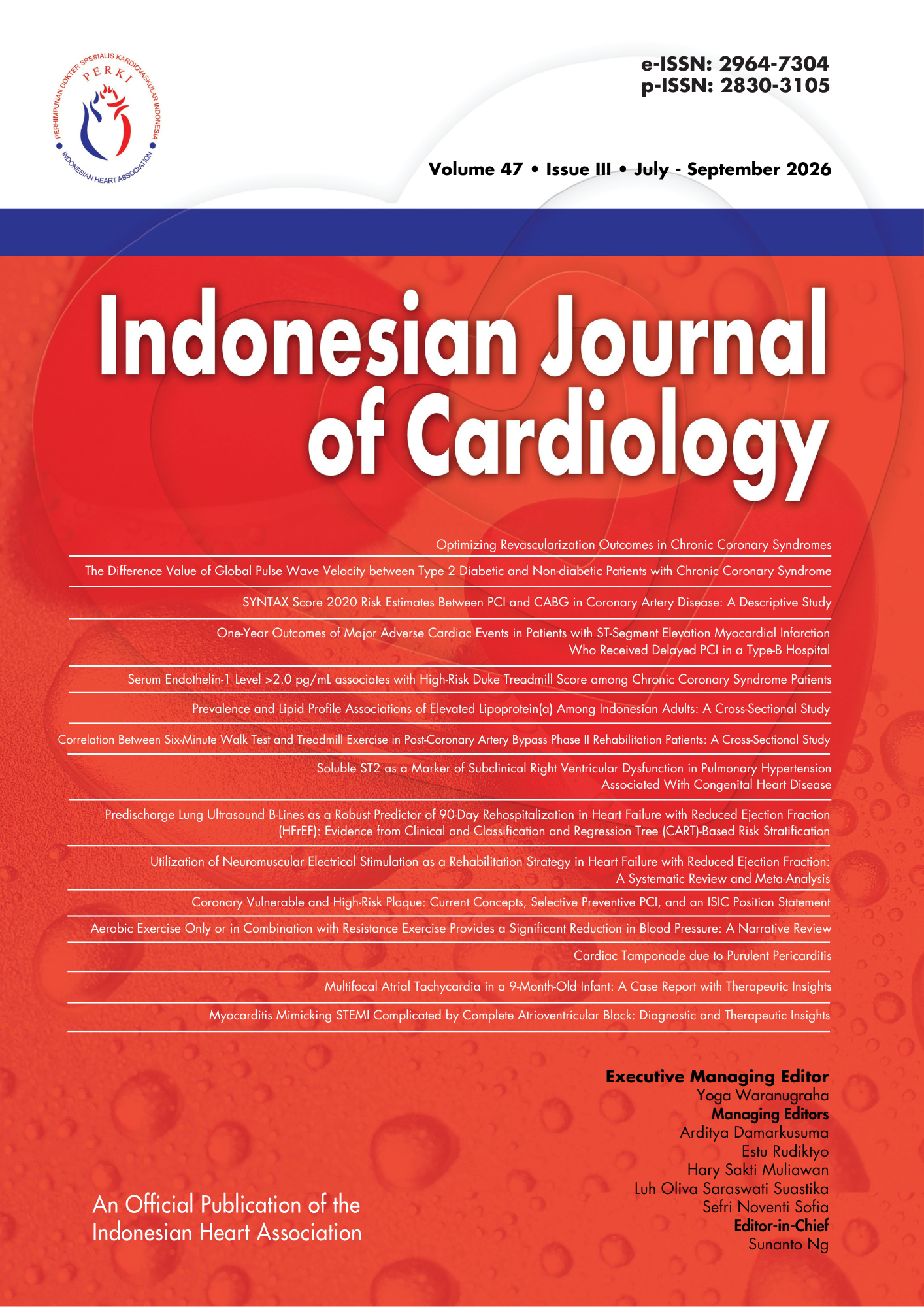
Coronary Vulnerable and High-Risk Plaque: Current Concepts, Selective Preventive PCI, and an ISIC Position Statement
DOI:
https://doi.org/10.30701/ijc.2316Keywords:
High-risk plaque, vulnerable plaque, preventive PCI, precision prevention, coronary computed tomography angiography, intravascular ultrasound, optical coherence tomography, biomarkers, bioresorbable scaffold, drug-coated balloonAbstract
The concept of coronary vulnerable plaque has evolved from a histopathological concept into a potential therapeutic target for precision cardiovascular prevention. Recent evidence has expanded this paradigm beyond the traditional vulnerable-plaque construct towards the broader concept of high-risk plaque, encompassing rupture-prone plaques, erosion-prone plaques, calcified nodules, plaque burden, inflammatory activity, healing capacity, and patient-level susceptibility to thrombosis.
Advances in Coronary Computed Tomography Angiography (CCTA), Intravascular Ultrasound (IVUS), Optical Coherence Tomography (OCT), Near-Infrared Spectroscopy (NIRS), molecular imaging, and Artificial Intelligence (AI) have substantially improved the detection and characterization of high-risk plaque. Circulating lipid, inflammatory, metabolic, and renal biomarkers provide complementary information regarding patient vulnerability. Concurrently, contemporary pharmacological therapy has substantially improved the natural history of coronary atherosclerosis by promoting plaque stabilization, fibrous cap thickening, lipid core regression, and attenuation of vascular inflammation.
The emergence of preventive Percutaneous Coronary Intervention (PCI) for non-flow-limiting vulnerable plaques, particularly following the PREVENT trial, has reignited interest in focal treatment before clinical destabilization. Nevertheless, important uncertainties remain regarding patient selection, diagnostic thresholds, imaging strategies, device selection, long-term durability, cost-effectiveness, and applicability in resource-limited healthcare systems. Drug-Eluting Stents (DES) remain the most established device platform, whereas next-generation bioresorbable scaffolds and Drug-Coated Balloons (DCB) may offer future approaches to local plaque treatment without permanent metallic implantation. Although Coronary Artery Bypass Grafting (CABG) does not directly treat vulnerable plaques, it may indirectly protect selected patients with diffuse multivessel disease by bypassing plaque-bearing coronary segments.
For Indonesia and other resource-constrained healthcare systems, future implementation should emphasize pragmatic implementation rather than widespread adoption of advanced technologies. Emphasis should remain on aggressive Optimal Medical Therapy (OMT), selective use of advanced imaging, careful identification of patients at the highest absolute cardiovascular risk, structured operator training, national registries, and rigorous evaluation of cost-effectiveness. The ultimate objective is not simply to detect more vulnerable plaques but to prevent more myocardial infarctions and cardiovascular deaths through efficient use of healthcare resources.
The Indonesian Society of Interventional Cardiology (ISIC) recommends that aggressive systemic prevention, centered on OMT, should remain the foundation of care. Advanced plaque imaging and preventive PCI should be reserved for carefully selected patients with converging high-risk plaque characteristics, high patient-level risk, and a favorable benefit–risk profile.
Downloads
References
2. Naghavi M, Libby P, Falk E, Casscells SW, Litovsky S, Rumberger J, Badimon JJ, Stefanadis C, Moreno P, Pasterkamp G, et al. From vulnerable plaque to vulnerable patient: a call for new definitions and risk assessment strategies: Part I. Circulation. 2003;108:1664–1672. doi: 10.1161/01.CIR.0000087480.94275.97
3. Silva Marques J, Pinto FJ. The vulnerable plaque: current concepts and future perspectives on coronary morphology, composition and wall stress imaging. Rev Port Cardiol. 2014;33:101–110. doi: 10.1016/j.repc.2013.07.017
4. Virmani R, Kolodgie FD, Burke AP, Farb A, Schwartz SM. Lessons from sudden coronary death: a comprehensive morphological classification scheme for atherosclerotic lesions. Arterioscler Thromb Vasc Biol. 2000;20:1262–1275. doi: 10.1161/01.atv.20.5.1262
5. Lee KY, Chang K. Understanding Vulnerable Plaques: Current Status and Future Directions. Korean Circ J. 2019;49:1115–1122. doi: 10.4070/kcj.2019.0211
6. Spagnolo M, Giacoppo D, Laudani C, Greco A, Finocchiaro S, Mauro MS, Imbesi A, Capodanno D. Advances in the Detection and Management of Vulnerable Coronary Plaques. Circ Cardiovasc Interv. 2025;18:e015529. doi: 10.1161/CIRCINTERVENTIONS.125.015529
7. Kim H, Ahn JM, Kang DY, Lee J, Choi Y, Park SJ, Park DW. Management of Coronary Vulnerable Plaque With Medical Therapy or Local Preventive Percutaneous Coronary Intervention. JACC Asia. 2024;4:425–443. doi: 10.1016/j.jacasi.2024.04.001
8. Sgreva S, Alsubai SE, Bianchini E, Alqahtani F, Del Sole PA, Elzomor H, Sharif R, Fezzi S, Sharif F. Plaques Do Not Act Alone: Time to Redefine Coronary Vulnerability from Lesion to Phenotype. J Clin Med. 2025;14:7568. doi: 10.3390/jcm14217568
9. Stone PH, Saito S, Takahashi S, Makita Y, Nakamura S, Kawasaki T, Takahashi A, Katsuki T, Nakamura S, Namiki A, et al. Prediction of progression of coronary artery disease and clinical outcomes using vascular profiling of endothelial shear stress and arterial plaque characteristics: the PREDICTION Study. Circulation. 2012;126:172–181. doi: 10.1161/CIRCULATIONAHA.112.096438
10. Vergallo R, Park SJ, Stone GW, Erlinge D, Porto I, Waksman R, Mintz GS, D'Ascenzo F, Seitun S, Saba L, et al. Vulnerable or High-Risk Plaque: A JACC: Cardiovascular Imaging Position Statement. JACC Cardiovasc Imaging. 2025;18:709–740. doi: 10.1016/j.jcmg.2024.12.004
11. Park SJ, Ahn JM, Kang DY, Yun SC, Ahn YK, Kim WJ, Nam CW, Jeong JO, Chae IH, Shiomi H, et al. Preventive percutaneous coronary intervention versus optimal medical therapy alone for the treatment of vulnerable atherosclerotic coronary plaques (PREVENT): a multicentre, open-label, randomised controlled trial. Lancet. 2024;403:1753–1765. doi: 10.1016/S0140-6736(24)00413-6
12. Harmadha WSP, Muharram FR, Gaspar RS, Azimuth Z, Sulistya HA, Firmansyah F, Multazam CECZ, Harits M, Putra RM. Explaining the increase of incidence and mortality from cardiovascular disease in Indonesia: a global burden of disease study analysis (2000–2019). PLoS One. 2023;18:e0294128. doi: 10.1371/journal.pone.0294128
13. Muharram FR, Multazam CECZ, Harmadha WSP, Andrianto A, Salsabilla SA, Dakota I, Andriantoro H, Firman D, Montain MM, Prakoso R, et al. Distribution of catheterisation laboratories in Indonesia 2017–2022: a nationwide survey. Lancet Reg Health Southeast Asia. 2024;26:100418. doi: 10.1016/j.lansea.2024.100418
14. Nurwahyuni A, Soewondo P, Nadjib M, Farianti Y, Mukhlisa MN, Wahyuningsih H, Mangunsong ER, Athiyah A, Yunita Y, Sayekti SAH, et al. Health care spending for cardiovascular disease under National Health Insurance Scheme in Indonesia before and during COVID-19: descriptive analysis and policy recommendations. J Indones Health Policy Adm. 2023;8:79–88. doi: 10.7454/ihpa.v8i2.6851
15. Stone GW, Maehara A, Lansky AJ, de Bruyne B, Cristea E, Mintz GS, Mehran R, McPherson J, Farhat N, Marso SP, et al. A prospective natural-history study of coronary atherosclerosis. N Engl J Med. 2011;364:226–235. doi: 10.1056/NEJMoa1002358
16. Prati F, Romagnoli E, Gatto L, La Manna A, Burzotta F, Ozaki Y, Marco V, Boi A, Fineschi M, Fabbiocchi F, et al. Relationship between coronary plaque morphology of the left anterior descending artery and 12 months clinical outcome: the CLIMA study. Eur Heart J. 2020;41:383–391. doi: 10.1093/eurheartj/ehz520
17. Kedhi E, Berta B, Roleder T, Hermanides RS, Fabris E, IJsselmuiden AJJ, Kauer F, Alfonso F, von Birgelen C, Escaned J, et al. Thin-cap fibroatheroma predicts clinical events in diabetic patients with normal fractional flow reserve: the COMBINE OCT-FFR trial. Eur Heart J. 2021;42:4671–4679. doi: 10.1093/eurheartj/ehab433
18. Waksman R, Di Mario C, Torguson R, Ali ZA, Singh V, Skinner WH, Artis AK, Cate TT, Powers E, Kim C, et al. Identification of patients and plaques vulnerable to future coronary events with near-infrared spectroscopy intravascular ultrasound imaging: a prospective, cohort study. Lancet. 2019;394:1629–1637. doi: 10.1016/S0140-6736(19)31794-5
19. Erlinge D, Maehara A, Ben-Yehuda O, Bøtker HE, Maeng M, Kjøller-Hansen L, Engstrøm T, Matsumura M, Crowley A, Dressler O, et al. Identification of vulnerable plaques and patients by intracoronary near-infrared spectroscopy and ultrasound (PROSPECT II): a prospective natural history study. Lancet. 2021;397:985–995. doi: 10.1016/S0140-6736(21)00249-X
20. Motoyama S, Sarai M, Harigaya H, Anno H, Inoue K, Hara T, Naruse H, Ishii J, Hishida H, Wong ND, et al. Computed tomographic angiography characteristics of atherosclerotic plaques subsequently resulting in acute coronary syndrome. J Am Coll Cardiol. 2009;54:49–57. doi: 10.1016/j.jacc.2009.02.068
21. Williams MC, Kwiecinski J, Doris M, McElhinney P, D'Souza MS, Cadet S, Adamson PD, Moss AJ, Alam S, Hunter A, et al. Low-Attenuation Noncalcified Plaque on Coronary Computed Tomography Angiography Predicts Myocardial Infarction: Results From the Multicenter SCOT-HEART Trial (Scottish Computed Tomography of the HEART). Circulation. 2020;141:1452–1462. doi: 10.1161/CIRCULATIONAHA.119.044720
22. Ferencik M, Mayrhofer T, Bittner DO, Emami H, Puchner SB, Lu MT, Meyersohn NM, Ivanov AV, Adami EC, Patel MR, et al. Use of High-Risk Coronary Atherosclerotic Plaque Detection for Risk Stratification of Patients With Stable Chest Pain: A Secondary Analysis of the PROMISE Randomized Clinical Trial. JAMA Cardiol. 2018;3:144–152. doi: 10.1001/jamacardio.2017.4973
23. Antonopoulos AS, Sanna F, Sabharwal N, Thomas S, Oikonomou EK, Herdman L, Margaritis M, Shirodaria C, Kampoli AM, Akoumianakis I, et al. Detecting human coronary inflammation by imaging perivascular fat. Sci Transl Med. 2017;9:eaal2658. doi: 10.1126/scitranslmed.aal2658
24. Joshi NV, Vesey AT, Williams MC, Shah AS, Calvert PA, Craighead FH, Yeoh SE, Wallace W, Salter D, Fletcher AM, et al. 18F-fluoride positron emission tomography for identification of ruptured and high-risk coronary atherosclerotic plaques: a prospective clinical trial. Lancet. 2014;383:705–713. doi: 10.1016/S0140-6736(13)61754-7
25. Dweck MR, Chow MW, Joshi NV, Williams MC, Jones C, Fletcher AM, Richardson H, White A, McKillop G, van Beek EJ, et al. Coronary arterial 18F-sodium fluoride uptake: a novel marker of plaque biology. J Am Coll Cardiol. 2012;59:1539–1548. doi: 10.1016/j.jacc.2011.12.037
26. Ali ZA, Maehara A, Généreux P, Shlofmitz RA, Fabbiocchi F, Nazif TM, Guagliumi G, Meraj PM, Alfonso F, Samady H, et al. Optical coherence tomography compared with intravascular ultrasound and with angiography to guide coronary stent implantation (ILUMIEN III: OPTIMIZE PCI): a randomised controlled trial. Lancet. 2016;388:2618–2628. doi: 10.1016/S0140-6736(16)31922-5
27. Ali ZA, Dager A, Zuniga M, Fonseca J, Arana C, Chamie D, Hill JM, Madder RD, Muller JE, Simonton CA, et al. First-in-Human Experience With a Novel Multimodality DeepOCT-NIRS Intracoronary Imaging System. J Soc Cardiovasc Angiogr Interv. 2024;3:101344. doi: 10.1016/j.jscai.2024.101344
28. Soffer DE, Marston NA, Maki KC, Jacobson TA, Bittner VA, Peña JM, Thanassoulis G, Martin SS, Kirkpatrick CF, Virani SS, et al. Role of apolipoprotein B in the clinical management of cardiovascular risk in adults: An Expert Clinical Consensus from the National Lipid Association. J Clin Lipidol. 2024;18:e647–e663. doi: 10.1016/j.jacl.2024.08.013
29. Kronenberg F, Mora S, Stroes ESG, Ference BA, Arsenault BJ, Berglund L, Dweck MR, Koschinsky ML, Lambert G, Mach F, et al. Lipoprotein(a) in atherosclerotic cardiovascular disease and aortic stenosis: a European Atherosclerosis Society consensus statement. Eur Heart J. 2022;43:3925–3946. doi: 10.1093/eurheartj/ehac361
30. Ridker PM, Everett BM, Thuren T, MacFadyen JG, Chang WH, Ballantyne C, Fonseca F, Nicolau J, Koenig W, Anker SD, et al. Antiinflammatory Therapy with Canakinumab for Atherosclerotic Disease. N Engl J Med. 2017;377:1119–1131. doi: 10.1056/NEJMoa1707914
31. Tardif JC, Kouz S, Waters DD, Bertrand OF, Diaz R, Maggioni AP, Pinto FJ, Ibrahim R, Gamra H, Kiwan GS, et al. Efficacy and Safety of Low-Dose Colchicine after Myocardial Infarction. N Engl J Med. 2019;381:2497–2505. doi: 10.1056/NEJMoa1912388
32. Nidorf SM, Fiolet ATL, Mosterd A, Eikelboom JW, Schut A, Opstal TSJ, The SHK, Xu XF, Ireland MA, Lenderink T, et al. Colchicine in Patients with Chronic Coronary Disease. N Engl J Med. 2020;383:1838–1847. doi: 10.1056/NEJMoa2021372
33. Jolly SS, d'Entremont MA, Lee SF, Mian R, Tyrwhitt J, Kedev S, Montalescot G, Cornel JH, Stankovi? G, Moreno R, et al. Colchicine in Acute Myocardial Infarction. N Engl J Med. 2025;392:633–642. doi: 10.1056/NEJMoa2405922
34. Nicholls SJ, Ballantyne CM, Barter PJ, Chapman MJ, Erbel RM, Libby P, Raichlen JS, Uno K, Borgman M, Wolski K, et al. Effect of two intensive statin regimens on progression of coronary disease. N Engl J Med. 2011;365:2078–2087. doi: 10.1056/NEJMoa1110874
35. Räber L, Koskinas KC, Yamaji K, Taniwaki M, Roffi M, Holmvang L, García-García HM, Zanchin T, Maldonado R, Moschovitis A, et al. Changes in Coronary Plaque Composition in Patients With Acute Myocardial Infarction Treated With High-Intensity Statin Therapy (IBIS-4): A Serial Optical Coherence Tomography Study. JACC Cardiovasc Imaging. 2019;12:1518–1528. doi: 10.1016/j.jcmg.2018.08.024
36. Cannon CP, Blazing MA, Giugliano RP, McCagg A, White JA, Theroux P, Darius H, Lewis BS, Ophuis TO, Jukema JW, et al. Ezetimibe Added to Statin Therapy after Acute Coronary Syndromes. N Engl J Med. 2015;372:2387–2397. doi: 10.1056/NEJMoa1410489
37. Sabatine MS, Giugliano RP, Keech AC, Honarpour N, Wiviott SD, Murphy SA, Kuder JF, Wang H, Liu T, Wasserman SM, et al. Evolocumab and Clinical Outcomes in Patients with Cardiovascular Disease. N Engl J Med. 2017;376:1713–1722. doi: 10.1056/NEJMoa1615664
38. Schwartz GG, Steg PG, Szarek M, Bhatt DL, Bittner VA, Diaz R, Edelberg JM, Goodman SG, Hanotin C, Harrington RA, et al. Alirocumab and Cardiovascular Outcomes after Acute Coronary Syndrome. N Engl J Med. 2018;379:2097–2107. doi: 10.1056/NEJMoa1801174
39. Räber L, Ueki Y, Otsuka T, Losdat S, Häner JD, Lønborg J, Fahrni G, Iglesias JF, van Geuns RJ, Ondracek AS, et al. Effect of alirocumab added to high-intensity statin therapy on coronary atherosclerosis in patients with acute myocardial infarction: the PACMAN-AMI randomized clinical trial. JAMA. 2022;327:1771–1781. doi: 10.1001/jama.2022.5218
40. Ray KK, Wright RS, Kallend D, Koenig W, Leiter LA, Raal FJ, Bisch JA, Richardson T, Jaros M, Wijngaard PLJ, et al. Two Phase 3 Trials of Inclisiran in Patients with Elevated LDL Cholesterol. N Engl J Med. 2020;382:1507–1519. doi: 10.1056/NEJMoa1912387
41. Yu M, Yang Y, Dong SL, Zhao C, Yang F, Yuan YF, Liao YH, He SL, Liu K, Wei F, et al. Effect of colchicine on coronary plaque stability in acute coronary syndrome as assessed by optical coherence tomography: the COLOCT randomized clinical trial. Circulation. 2024;150:981–993. doi: 10.1161/CIRCULATIONAHA.124.069808
42. Stone GW, Maehara A, Ali ZA, Held C, Matsumura M, Kjøller-Hansen L, Bøtker HE, Maeng M, Engstrøm T, Wiseth R, et al. Percutaneous Coronary Intervention for Vulnerable Coronary Atherosclerotic Plaque. J Am Coll Cardiol. 2020;76:2289–2301. doi: 10.1016/j.jacc.2020.09.547
43. Serruys PW, Chevalier B, Sotomi Y, Cequier A, Carrie D, Piek JJ, Van Boven AJ, Dominici M, Dudek D, McClean D, et al. Comparison of an everolimus-eluting bioresorbable scaffold with an everolimus-eluting metallic stent for the treatment of coronary artery stenosis (ABSORB II): a 3 year, randomised, controlled, single-blind, multicentre clinical trial. Lancet. 2016;388:2479–2491. doi: 10.1016/S0140-6736(16)32050-5
Downloads
Published
How to Cite
Issue
Section
License
Authors who publish with this journal agree to the following terms:
- Authors retain copyright and grant the journal right of first publication with the work simultaneously licensed under a Creative Commons Attribution License that allows others to share the work with an acknowledgement of the work's authorship and initial publication in this journal.
- Authors are able to enter into separate, additional contractual arrangements for the non-exclusive distribution of the journal's published version of the work (e.g., post it to an institutional repository or publish it in a book), with an acknowledgement of its initial publication in this journal.
- Authors are permitted and encouraged to post their work online (e.g., in institutional repositories or on their website) prior to and during the submission process, as it can lead to productive exchanges, as well as earlier and greater citation of published work (See The Effect of Open Access).