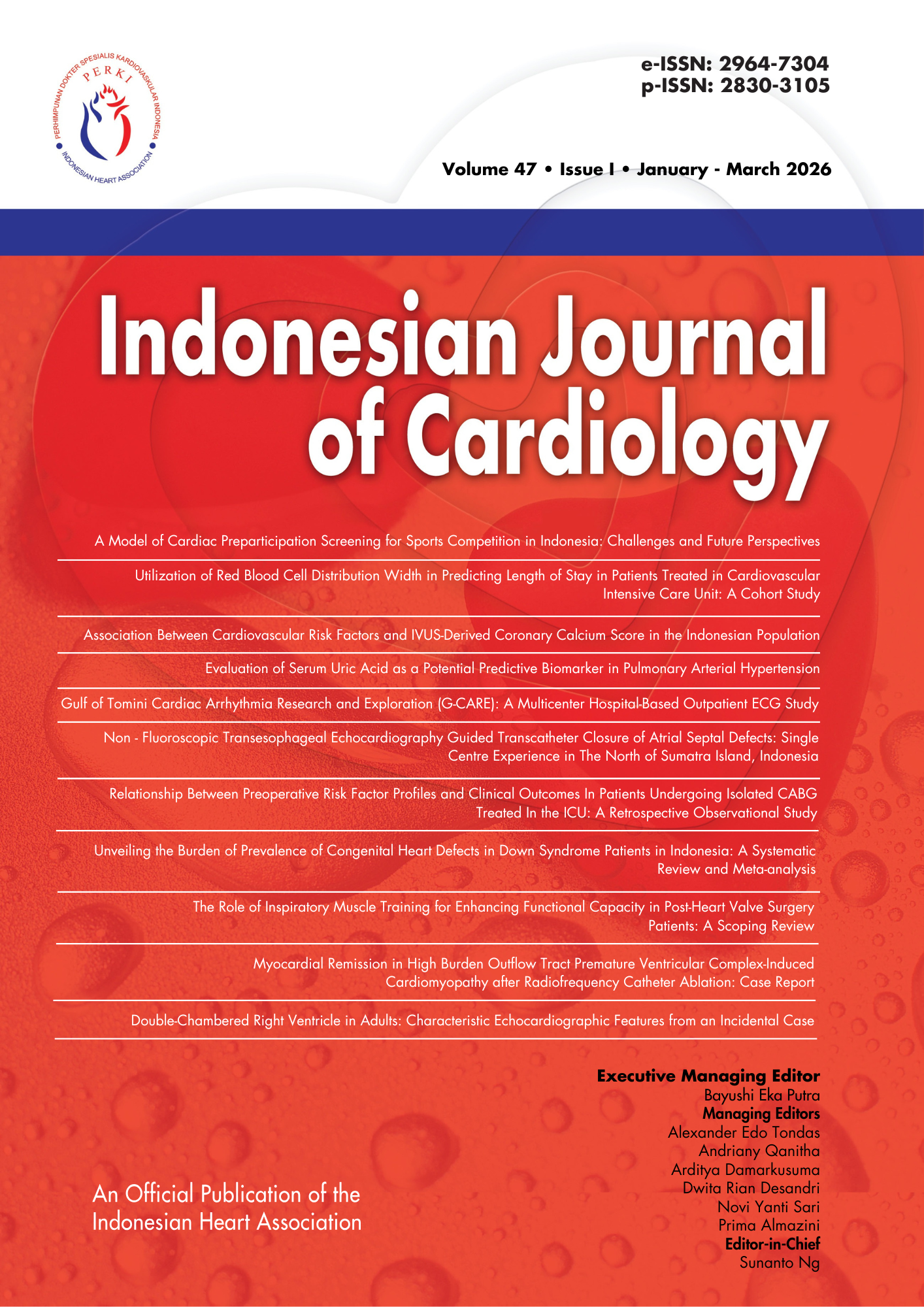
Gulf of Tomini Cardiac Arrhythmia Research and Exploration (G-CARE): A Multicenter Hospital-Based Outpatient ECG Study
Abstract
Introduction: Cardiac arrhythmias pose a significant burden on global health, especially in underserved regions with limited access to diagnostics. In Indonesia, particularly in the Gulf of Tomini, epidemiologic data on arrhythmia prevalence are scarce.
Methods: The G-CARE (Gulf of Tomini Cardiac Arrhythmia Research and Exploration) study was a hospital-based, multicenter, cross-sectional study conducted from 2023–2025 across four referral centers in Gorontalo Province. Adults aged ≥18 years who underwent 12-lead ECG examination were included through purposive sampling. ECGs were interpreted by board-certified cardiologists and classified by arrhythmia type.
Results: A total of 3,177 patients were included (mean age: 53.9±14.9 years; 54.6% female). Normal ECGs were found in 43.4%. The most common abnormalities were ischemic ST-T changes (18.9%, 95% CI: 17.5–20.3), QTc prolongation (15.5%, 95% CI: 14.2–16.8), and left ventricular hypertrophy (10.1%, 95% CI: 9.1–11.2). Atrial fibrillation/flutter occurred in 3.5% (95% CI: 2.8–4.3), AV block in 3.7% (95% CI: 3.0–4.5), and Brugada Pattern in 0.4% (95% CI: 0.2–0.8). Age-related increases were observed for AF, AV block, and QT prolongation. PVC morphology showed high-risk features (QRS >160 ms, coupling interval <300 ms) in young adults.
Conclusion: The G-CARE study identifies a high prevalence of electrocardiographic abnormalities among adults undergoing ECG in outpatient settings within the Gulf of Tomini region. Because the study used hospital-based, purposive sampling of patients who had an ECG ordered as part of routine clinical care, these estimates may be amplified by selection bias and do not directly represent the general population. Rather than serving as definitive evidence to support mass, population-level ECG screening, our findings should be considered hypothesis-generating and supportive of conducting a properly designed population-based study (with probability sampling) to determine the true community burden and to inform screening policy.
Downloads
References
2. Lakshminarayan K, Anderson DC, Herzog CA, Qureshi AI. Clinical epidemiology of atrial fibrillation and related cerebrovascular events in the United States. Neurologist. 2008 May;14(3):143-50. doi: 10.1097/NRL.0b013e31815cffae. PMID: 18469671; PMCID: PMC5619693.
3. Shimizu W, Kusumoto FM, Agbayani MF, Apiyasawat S, Chen M, Ching CK, Choi JI, Dan Do VB, Hanafy DA, Hurwitz JL, Johar S, Kalman JM, Khan AHH, Khmao P, Krahn AD, Ngarmukos T, Binh Nguyen ST, Nwe N, Oh S, Soejima K, Stiles MK, Tsao HM, Tseveendee S. Statement from the Asia Summit: Current state of arrhythmia care in Asia. Heart Rhythm O2. 2023 Sep 27;4(11):741-755. doi: 10.1016/j.hroo.2023.08.005. PMID: 38034890; PMCID: PMC10685152.
4. Mkoko P, Bahiru E, Ajijola OA, Bonny A, Chin A. Cardiac arrhythmias in low- and middle-income countries. Cardiovasc Diagn Ther. 2020 Apr;10(2):350-360. doi: 10.21037/cdt.2019.09.21. PMID: 32420117; PMCID: PMC7225444.
5. Siregar MNI, Wahidji VH. A rare case of posterolateral ST-segment elevation myocardial infarction in Brugada syndrome: A double trouble beyond mimicking. Kardiol Pol. 2024;82(11):1165-1167. doi: 10.33963/v.phj.103242. Epub 2024 Nov 13. PMID: 39535954.
6. Siregar MNI, Wahidji VH. Impact of hypokalemia on Brugada syndrome: case report unveiling mechanisms beyond QT interval prolongation. Egypt Heart J. 2024 Oct 22;76(1):143. doi: 10.1186/s43044-024-00574-3. PMID: 39436493; PMCID: PMC11496434.
7. Amir M, Irwan, Syafaryuni M, Levina. Prevalence and characteristics of atrial fibrillation in Makassar city population: A telemedicine study. Gac Sanit. 2021;35 Suppl 2:S510-S514. doi: 10.1016/j.gaceta.2021.10.082. PMID: 34929888.
8. Yuniadi Y, Supit AI, Hanafy DA, Raharjo SB, Hermanto DY, Basalamah F, Hartono B, Agustinus R, Chandranegara AF, Ahmad C, Iqbal M, Tondas AE, El-Rasyid H, Haryadi H, Lukito AA, Tanubudi D, Yansen I, Maharani E, Julario R, Rizal A, Antara PS, Amir M. Prevalence of atrial fibrillation based on tertiary hospital survey in Indonesia: A smartphone-based diagnosis. J Arrhythm. 2024 Aug 22;40(5):1102-1107. doi: 10.1002/joa3.13137. PMID: 39416241; PMCID: PMC11474569.
9. Kementerian Kesehatan Republik Indonesia. Survei Kesehatan Indonesia (SKI) 2023 Dalam Angka Data Akurat Kebijakan Tepat [Internet]. Jakarta; 2023 [dikutip 11 Maret 2025]. Tersedia pada: https://www.badankebijakan.kemkes.go.id/hasil-ski-2023/
10. Ma, Q., Li, Z., Guo, X. et al. Prevalence and risk factors of prolonged corrected QT interval in general Chinese population. BMC Cardiovasc Disord 19, 276 (2019). https://doi.org/10.1186/s12872-019-1244-7
11. Birda CL, Kumar S, Bhalla A, Sharma N, Kumari S. Prevalence and prognostic significance of prolonged QTc interval in emergency medical patients: A prospective observational study. Int J Crit Illn Inj Sci. 2018 Jan-Mar;8(1):28-35. doi: 10.4103/IJCIIS.IJCIIS_59_17. PMID: 29619337; PMCID: PMC5869797.
12. Veglio M, Bruno G, Borra M, Macchia G, Bargero G, D'Errico N, Pagano GF, Cavallo-Perin P. Prevalence of increased QT interval duration and dispersion in type 2 diabetic patients and its relationship with coronary heart disease: a population-based cohort. J Intern Med. 2002 Apr;251(4):317-24. doi: 10.1046/j.1365-2796.2002.00955.x. PMID: 11952882.
13. Aburisheh, K., AlKheraiji, M.F., Alwalan, S.I. et al. Prevalence of QT prolongation and its risk factors in patients with type 2 diabetes. BMC Endocr Disord 23, 50 (2023). https://doi.org/10.1186/s12902-022-01235-9
14. Janakiraman, S., Arivazhagan, R. B., & Chinnusamy, M. (2022). Prevalence of QTc prolongation among hypertensive patients and its association with other co-morbidities. International Journal of Advances in Medicine, 9(3), 300–305. https://doi.org/10.18203/2349-3933.ijam20220434
15. Kusumoto FM, Bailey KR, Chaouki AS, et al. Systematic review for the 2017 AHA/ACC/HRS guideline for management of patients with ventricular arrhythmias and the prevention of sudden cardiac death: a report of the American College of Cardiology/American Heart Association Task Force on Clinical Practice Guidelines and the Heart Rhythm Society. Circulation. 2018;138:e392–e414.
16. Chen Q, Yi Z, Cheng J. Atrial fibrillation in aging population. Aging Med (Milton). 2018 Apr 23;1(1):67-74. doi: 10.1002/agm2.12015. PMID: 31942483; PMCID: PMC6880740.
17. Goyal P, Rich MW. Electrophysiology and heart rhythm disorders in older adults. J Geriatr Cardiol. 2016 Aug;13(8):645-651. doi: 10.11909/j.issn.1671-5411.2016.08.001. PMID: 27781053; PMCID: PMC5067424.
18. Prisco AR, Castro JR, Roukoz H, Tholakanahalli VN. Premature Ventricular Complexes: Benign versus Malignant - How to approach? Indian Pacing Electrophysiol J. 2023 Nov-Dec;23(6):189-195. doi: 10.1016/j.ipej.2023.09.004. Epub 2023 Sep 13. PMID: 37714513; PMCID: PMC10685167.
19. Amir M, Mappangara I, Setiadji R, Zam SM. Characteristics and Prevalence of Premature Ventricular Complex: A Telemedicine Study. Cardiol Res. 2019 Oct;10(5):285-292. doi: 10.14740/cr887. Epub 2019 Oct 4. PMID: 31636796; PMCID: PMC6785296.
20. Calò L, Panattoni G, Tatangelo M, Brunetti G, Graziano F, Monzo L, Danza ML, Fedele E, Grieco D, Crescenzi C, Rebecchi M, Stazi A, Bressi E, De Ruvo E, Golia P, Gaita F, Corrado D, Zorzi A. Electrocardiographic characteristics of right-bundle-branch-block premature ventricular complexes predicting absence of left ventricular scar in athletes with apparently structural normal heart. Europace. 2023 Jul 4;25(7):euad217. doi: 10.1093/europace/euad217. PMID: 37466354; PMCID: PMC10374981.
21. Tsiachris, D., Botis, M., Doundoulakis, I., Bartsioka, L. I., Tsioufis, P., Kordalis, A., Antoniou, C.-K., Tsioufis, K., & Gatzoulis, K. A. (2023). Electrocardiographic Characteristics, Identification, and Management of Frequent Premature Ventricular Contractions. Diagnostics, 13(19), 3094. https://doi.org/10.3390/diagnostics13193094
22. Bajaj, S., Bennett, M. T., & Rabkin, S. W. (2023). Identifying Premature Ventricular Complexes from Outflow Tracts Based on PVC Configuration: A Machine Learning Approach. Journal of Clinical Medicine, 12(17), 5558. https://doi.org/10.3390/jcm12175558
23. Darar C, Mohammed EA, Mohammed B, Noha EO, Zakaria B. Risk stratification of sudden cardiac death in Brugada syndrome: an updated review of literature. Egypt Heart J. 2022 Apr 11;74(1):25. doi: 10.1186/s43044-022-00267-9. PMID: 35404008; PMCID: PMC9001772.
24. Octavianus, R., & Yuniadi, Y. (1). Brugada Syndrome: Diagnosis and Management. Indonesian Journal of Cardiology, 33(2), 113-26. https://doi.org/10.30701/ijc.v33i2.62
25. Khawaja, M., Qadeer, Y. K., Siddiqui, R., Chelu, M. G., Aiumtrakul, N., Pickett, J. K., Brugada, R., Brugada, J., Brugada, P., & Krittanawong, C. (2023). Brugada Syndrome within Asian Populations: State-of-the-Art Review. Cardiogenetics, 13(2), 61-74. https://doi.org/10.3390/cardiogenetics13020007
26. Chhabra L, Goyal A, Benham MD. Wolff-Parkinson-White Syndrome. [Updated 2023 Aug 7]. In: StatPearls [Internet]. Treasure Island (FL): StatPearls Publishing; 2025 Jan-. Available from: https://www.ncbi.nlm.nih.gov/books/NBK554437/
27. Ghani A, Maas AH, Delnoy PP, Ramdat Misier AR, Ottervanger JP, Elvan A. Sex-Based Differences in Cardiac Arrhythmias, ICD Utilisation and Cardiac Resynchronisation Therapy. Neth Heart J. 2011 Jan;19(1):35-40. doi: 10.1007/s12471-010-0050-8. PMID: 22020857; PMCID: PMC3077833.
28. Asatryan B and Barth AS (2023) Sex-related differences in incidence, phenotype and risk of sudden cardiac death in inherited arrhythmia syndromes. Front. Cardiovasc. Med. 9:1010748. doi: 10.3389/fcvm.2022.1010748
29. HRS/EHRA/APHRS Expert Consensus Statement on the Diagnosis and Management of Patients with Inherited Primary Arrhythmia Syndromes Priori, Silvia G. et al. Heart Rhythm, Volume 10, Issue 12, 1932 – 1963
30. Sugrue A, Rohatgi RK, Bos M, Vaidya VR, Asirvatham SJ, Noseworthy PA, Ackerman MJ. Clinical Significance of Early Repolarization in Long QT Syndrome. JACC Clin Electrophysiol. 2018 Sep;4(9):1238-1244. doi: 10.1016/j.jacep.2018.06.007. Epub 2018 Aug 29. PMID: 30236400.
PDF downloads: 355
Copyright (c) 2026 Indonesian Journal of Cardiology

This work is licensed under a Creative Commons Attribution 4.0 International License.
Authors who publish with this journal agree to the following terms:
- Authors retain copyright and grant the journal right of first publication with the work simultaneously licensed under a Creative Commons Attribution License that allows others to share the work with an acknowledgement of the work's authorship and initial publication in this journal.
- Authors are able to enter into separate, additional contractual arrangements for the non-exclusive distribution of the journal's published version of the work (e.g., post it to an institutional repository or publish it in a book), with an acknowledgement of its initial publication in this journal.
- Authors are permitted and encouraged to post their work online (e.g., in institutional repositories or on their website) prior to and during the submission process, as it can lead to productive exchanges, as well as earlier and greater citation of published work (See The Effect of Open Access).