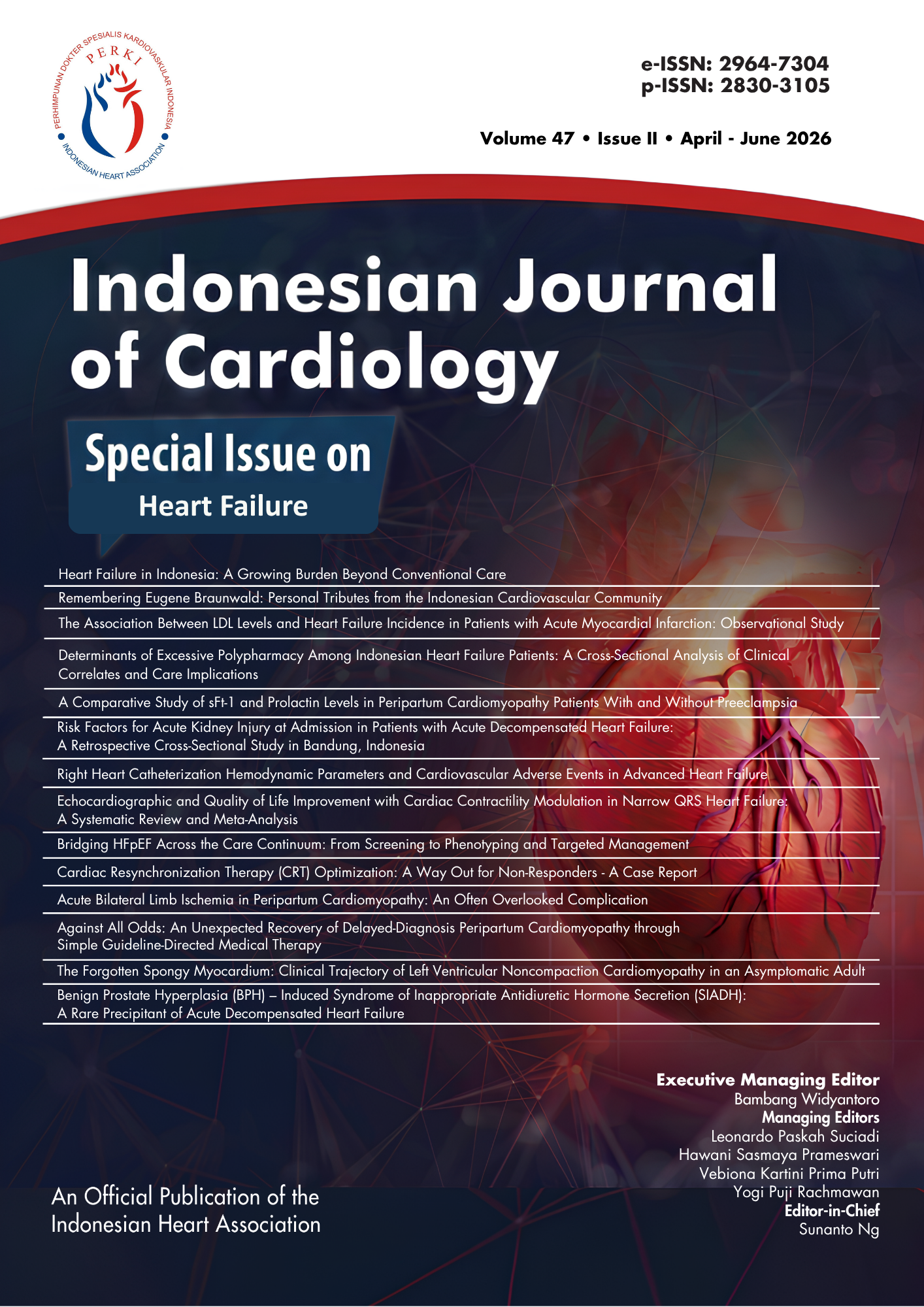
Excessive Polypharmacy Among Indonesian Heart Failure Patients: Clinical Correlates and Care Implications
Abstract
Background: Heart Failure (HF) is a major global health problem that often coexists with multiple chronic comorbidities, requiring complex pharmacotherapy. The use of numerous concurrent medications increases the risk of polypharmacy and excessive polypharmacy, which may lead to adverse drug reactions, drug–drug interactions, poor adherence, and higher healthcare utilization. Despite growing awareness of this issue, evidence on the prevalence and determinants of excessive polypharmacy among Indonesian HF patients remains scarce.
Methods: This single-center cross-sectional sub-analysis was derived from a cross-sectional study involving 494 adult HF patients treated at Hasna Medika Cardiovascular Hospital, Cirebon, between January and December 2023. HF diagnosis was confirmed by cardiologists using the European Society of Cardiology (ESC) criteria. Polypharmacy was defined as the use of ≥7 medications, while excessive polypharmacy was defined as ≥10 medications. Clinical and demographic variables were extracted from electronic medical records (EMR). Bivariate analysis was performed using Chi-square or Fisher’s exact tests, followed by multivariate logistic regression to identify independent determinants of excessive polypharmacy.
Results: The mean age of participants was 58.1 ± 10.5 years, and 53.4% were male. Overall, 42.5% of patients met the criteria for polypharmacy, and 15.6% (n=77) met the criteria for excessive polypharmacy. The most frequent comorbidities were Coronary Artery Disease (CAD) (80.2%), hypertension (23.1%), and Type 2 Diabetes Mellitus (T2DM, 20.0%). In multivariate analysis, T2DM (Adjusted Odds Ratio [AOR] 17.21, 95% CI 8.39–35.34), Chronic Kidney Disease (CKD) (AOR 5.97, 95% CI 2.37–15.03), Chronic Obstructive Pulmonary Disease (COPD) (AOR 6.64, 95% CI 2.64–16.69), and asthma (AOR 26.32, 95% CI 5.79–119.67) were identified as independent determinants of excessive polypharmacy. The model demonstrated good fit (McFadden pseudo-R² = 0.351; Hosmer–Lemeshow p = 0.62).
Conclusion: Excessive medication burden is common among HF patients, particularly among those with metabolic and pulmonary comorbidities. These findings highlight the need for systematic medication review and rational prescribing strategies while recognizing that higher medication counts do not necessarily indicate inappropriate prescribing.
Downloads
References
2. Reyes EB, Ha JW, Firdaus I, Ghazi AM, Phrommintikul A, Sim D, et al. Heart failure across Asia: Same healthcare burden but differences in organization of care. Int J Cardiol. 2016; 223:163–7.
3. Feng J, Zhang Y, Zhang J. Epidemiology and Burden of Heart Failure in Asia. JACC: Asia. 2024;4(4):249–64.
4. McDonagh TA, Metra M, Adamo M, Gardner RS, Baumbach A, Bohm M, et al. 2023 Focused Update of the 2021 ESC Guidelines for the diagnosis and treatment of acute and chronic heart failure. Eur Heart J. 2023;1–13.
5. Savarese G, Lund LH. Global public health burden of heart failure. Card Fail Rev. 2017;3(1):7–11.
6. Indonesian Health Profile 2023. Ministry of Health, Republic of Indonesia. 2024.
7. Ponikowski P, Voors AA, Anker SD, et al. 2021 ESC Guidelines for the diagnosis and treatment of acute and chronic heart failure. Eur Heart J. 2021;42(36):3599–726.
8. Heidenreich PA, Bozkurt B, Aguilar D, et al. 2022 AHA/ACC/HFSA Heart Failure Guidelines. J Am Coll Cardiol. 2022;79(17): e263–421.
9. Masnoon N, Shakib S, Kalisch-Ellett L, Caughey GE. What is polypharmacy? A systematic review of definitions. BMC Geriatr. 2017;17(1):230.
10. Schuler J, Dückelmann C, Beindl W, Prinz E, Michalski T, Pichler M. Polypharmacy and inappropriate prescribing in elderly internal-medicine patients in Austria. Wien Klin Wochenschr. 2008;120(23–24):733–41.
11. Yancy CW, Jessup M, Bozkurt B, et al. 2017 ACC/AHA/HFSA Focused update on the 2013 heart failure guideline. Circulation. 2017;136: e137–61.
12. Patel P, Carson PE. Comorbidities in heart failure. Curr Heart Fail Rep. 2019;16(4):209–18.
13. Maher RL, Hanlon J, Hajjar ER. Clinical consequences of polypharmacy in elderly. Expert Opin Drug Saf. 2014;13(1):57–65.
14. Rachmawan YP, Pratiwi W, Loebis IM, Prihandono DH, Irnizarifka I, Pramudya A, Anshar R, Junior NN. Polypharmacy in Heart Failure Patients: In the Era of Guidelines-Based Therapy Optimization. SEEJPH. 2025;19(7):3934-43.
15. Patterson SM, Cadogan CA, Kerse N, et al. Interventions to improve the appropriate use of polypharmacy for older people. Cochrane Database Syst Rev. 2014;(10):CD008165.
16. Unlu O, Levitan EB, Reshetnyak E, Kneifati-Hayek J, Diaz I, Archambault A, et al. Polypharmacy in Older Adults Hospitalized for Heart Failure. Circ Heart Fail. 2020 Nov;13(11): e006977.
17. Minamisawa M, Claggett B, Suzuki K, Hegde SM, Shah AM, Desai AS, et al. Association of Hyper-Polypharmacy with Clinical Outcomes in Heart Failure with Preserved Ejection Fraction. Circ Heart Fail. 2021 Nov;14(11).
18. Yancy CW, Jessup M, Bozkurt B, et al. Medical therapy for heart failure: where are we? J Am Coll Cardiol. 2023;81(12):1181–93.
19. Siswanto BB, Pratikno RS, Lubis AR, Putrinarita AD, Lubis AC, Indradew T, Dewi PP, Sarastri Y, Zulkarnain E, Arifianto H, Suryana NM, Kartini VP, Rachmawan YP, Hartopo AB, Wiryawan IN, Sirait SP, Astari LV, Sasmaya H, Hasanah DY, Suryani LD, Soedarsono WA, Irnizarifka, Nauli SE, et al. Farmakoterapi pada gagal jantung. Jakarta: PT Scifintech Andrew Wijaya; 2023. ISBN 978-623-09-2938-0.
20. Tromp J, Tay WT, Ouwerkerk W, et al. Comorbidities in heart failure with preserved vs reduced ejection fraction. J Am Coll Cardiol. 2019;73(21):2634–48.
21. Dewan P, Rørth R, Jhund PS, et al. Comorbidity burden and polypharmacy in heart failure across the world. Eur J Heart Fail. 2020;22(2):231–41.
22. Zelniker TA, Braunwald E. Mechanisms of cardiorenal and metabolic disease interplay. N Engl J Med. 2023; 389:1125–37.
23. Standl E, Schnell O, McGuire DK. Heart failure considerations of antihyperglycemic medications for type 2 diabetes. Circ Res. 2016;118(11):1830–43.
24. McMurray JJV, Solomon SD, Inzucchi SE, et al. Dapagliflozin in patients with heart failure and reduced ejection fraction. N Engl J Med. 2019; 381:1995–2008.
25. Dei Cas A, Khan SS, Butler J, Mentz RJ, Bonow RO, Avogaro A, et al. Impact of Diabetes on Epidemiology, Treatment, and Outcomes of Patients with Heart Failure. JACC Heart Fail. 2015;3(2):136–45.
26. Damman K, Testani JM. The kidney in heart failure: an update. Eur Heart J. 2021;42(2):148–57.
27. Green D, James B, Hussain N. Pharmacological management of cardio-renal-metabolic disease including new potassium binders. Medicine. 2023;51(3):176–9.
28. Joseph J, et al. Pharmacotherapy in heart failure with renal dysfunction. Curr Heart Fail Rep. 2022;19(1):1–12.
29. Kolkailah AA, et al. Clinical outcomes associated with polypharmacy in patients with chronic kidney disease. Nephrol Dial Transplant. 2020;35(7):1170–8.
30. Agarwal R, Rossignol P. Management of hyperkalemia in HF and CKD. Kidney Int. 2023;103(4):706–18.
31. Ingebrigtsen TS, Marott JL, Vestbo J, et al. Coronary heart disease and heart failure in asthma, COPD and asthma-COPD overlap. BMJ Open Respir Res. 2020;7(1): e000470.
32. Matera MG, Hanania NA, Maniscalco M, Cazzola M. Pharmacotherapies in older adults with COPD: challenges and opportunities. Drugs Aging. 2023;40(7):605–19.
33. Cazzola M, Page CP, Hanania NA, et al. Asthma and cardiovascular diseases: navigating mutual pharmacological interferences. Drugs. 2024;84(10):1251–73.
PDF downloads: 374
Copyright (c) 2026 Indonesian Journal of Cardiology

This work is licensed under a Creative Commons Attribution 4.0 International License.
Authors who publish with this journal agree to the following terms:
- Authors retain copyright and grant the journal right of first publication with the work simultaneously licensed under a Creative Commons Attribution License that allows others to share the work with an acknowledgement of the work's authorship and initial publication in this journal.
- Authors are able to enter into separate, additional contractual arrangements for the non-exclusive distribution of the journal's published version of the work (e.g., post it to an institutional repository or publish it in a book), with an acknowledgement of its initial publication in this journal.
- Authors are permitted and encouraged to post their work online (e.g., in institutional repositories or on their website) prior to and during the submission process, as it can lead to productive exchanges, as well as earlier and greater citation of published work (See The Effect of Open Access).