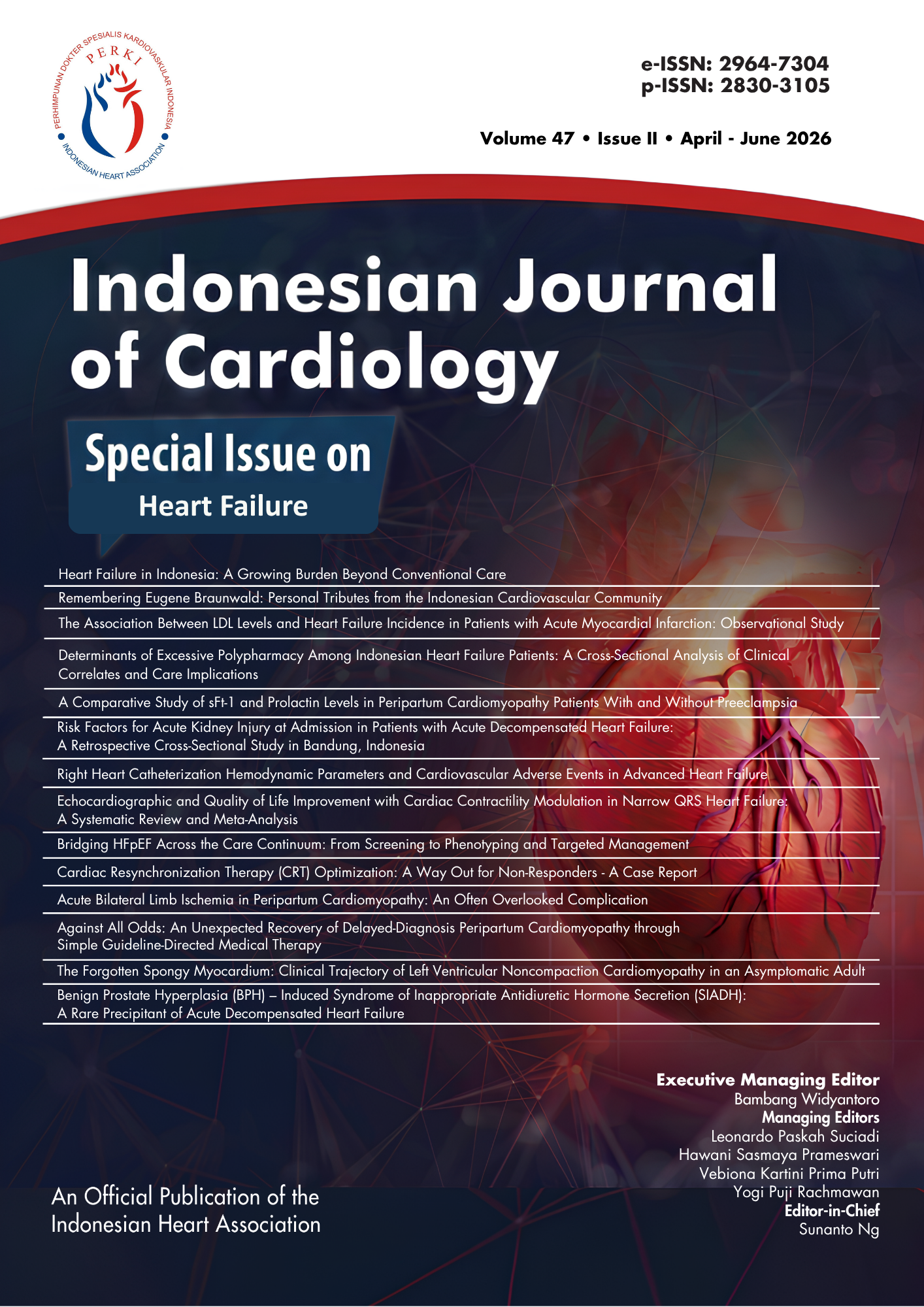
Right Heart Catheterization Hemodynamic Parameters and Cardiovascular Adverse Events in Advanced Heart Failure: A Retrospective Cohort Study
Abstract
Background: Right Heart Catheterization (RHC) is an important tool in advanced heart failure because it provides invasive assessment of hemodynamics, congestion, pulmonary hypertension, and right ventricular function, and helps determine candidacy for advanced therapies. However, the prognostic value of RHC-derived hemodynamic parameters in real-world advanced heart failure remains unclear. This study aimed to describe the clinical, echocardiographic, and invasive hemodynamic characteristics of patients with advanced heart failure undergoing RHC and to explore their association with Cardiovascular Adverse Events (CVAE).
Methods: This retrospective cohort study was conducted at two tertiary referral centers in Indonesia. Consecutive adult patients with advanced heart failure who underwent RHC were included. The primary outcome was CVAE, defined as a composite of cardiovascular death or rehospitalization due to acute heart failure, arrhythmia, or cardiogenic shock during a median follow-up of 6 (IQR 3-12) months after the index RHC. Baseline clinical, echocardiographic, and invasive hemodynamic data were collected from medical records and catheterization reports. No formal sample size calculation was performed. Patients with and without CVAE were compared, and bivariate logistic regression was used to explore associations between hemodynamic parameters and CVAE.
Results: A total of 33 patients were included, and 22 (68.6%) developed CVAE. Mean age was 48.0 ± 11.3 years, and 29 patients (87.9%) were male. Most patients were INTERMACS profile 4, and 27 (81.8%) had combined post- and pre-capillary pulmonary hypertension. Compared with 11 patients without CVAE, the 22 patients with CVAE had lower cardiac output (3.23 ± 0.8 vs 3.99 ± 1.1 L/min; p=0.027), lower cardiac index (1.85 ± 0.4 vs 2.34 ± 0.7 L/min/m²; p=0.019), and lower pulmonary artery pulsatility index (0.56 [0.14-1.31] vs 1.35 [0.53-4.38]; p=0.044). Other hemodynamic parameters were not significantly different. In bivariate logistic regression, higher cardiac output, cardiac index, and pulmonary artery pulsatility index were associated with lower odds of CVAE.
Conclusion: In this two-center retrospective cohort of patients with advanced heart failure undergoing RHC, lower cardiac output, lower cardiac index, and lower pulmonary artery pulsatility index were associated with CVAE, whereas conventional pressure-based and pulmonary vascular parameters were not. These findings suggest that impaired forward flow and reduced right ventricular-pulmonary arterial pulsatile reserve may be important for risk stratification in advanced heart failure.
Downloads
References
2. Peled Y, Ducharme A, Kittleson M, et al. International Society for Heart and Lung Transplantation guidelines for the evaluation and care of cardiac transplant candidates-2024. J Heart Lung Transplant. 2024;43.
3. Rajagopalan N, Rajagopalan N, Borlaug B, Bailey A, et al. Practical guidance for hemodynamic assessment by right heart catheterization in management of heart failure. JACC Heart Fail. 2024;12:1141-1156.
4. Zeder K, Mak S, Galie N, et al. Right heart catheterization in heart failure: indications, interpretation, and pitfalls. Eur Heart J. 2025;46:3354-3372.
5. Grinstein J, Houston BA, Nguyen AB, et al. Standardization of the right heart catheterization and the emerging role of advanced hemodynamics in heart failure. J Card Fail. 2023;29:1543-1555.
6. Lam CS, Teng TK, Tay WT, et al. Regional and ethnic differences among patients with heart failure in Asia: the Asian sudden cardiac death in heart failure registry. Eur Heart J. 2016;37:3141-3153.
7. Wan Ahmad WA, Abdul Ghapar AK, Zainal Abidin HA, et al. Characteristics of patients admitted with heart failure: insights from the first Malaysian Heart Failure Registry. ESC Heart Fail. 2024;11:727-736.
8. Lainščak M, Milinkovic I, Polovina M, et al. Sex- and age-related differences in the management and outcomes of chronic heart failure: an analysis of patients from the ESC HFA EORP Heart Failure Long-Term Registry. Eur J Heart Fail. 2020;22:92-102.
9. Abraham WT, Adams KF, Fonarow GC, et al. In-hospital mortality in patients with acute decompensated heart failure requiring intravenous vasoactive medications: an analysis from the Acute Decompensated Heart Failure National Registry (ADHERE). J Am Coll Cardiol. 2005;46:57-64.
10. Stevenson LW, Pagani FD, Young JB, et al. INTERMACS profiles of advanced heart failure: the current picture. J Heart Lung Transplant. 2009;28:535-541.
11. Stewart GC, Kittleson MM, Patel PC, et al. INTERMACS (Interagency Registry for Mechanically Assisted Circulatory Support) profiling identifies ambulatory patients at high risk on medical therapy after hospitalizations for heart failure. Circ Heart Fail. 2016;9
12. Palardy M, McLean R, Pamboukian S, et al. The REVIVAL Registry of ambulatory advanced heart failure: baseline characteristics. J Heart Lung Transplant. 2017;36:S211.
13. Lucas C, Johnson W, Hamilton MA, et al. Freedom from congestion predicts good survival despite previous class IV symptoms of heart failure. Am Heart J. 2000;140:840-847.
14. Gheorghiade M, Filippatos G, De Luca L, et al. Congestion in acute heart failure syndromes: an essential target of evaluation and treatment. Am J Med. 2006;119:S3-S10.
15. Yoon M, Youn JC. Right heart catheterization in patients with advanced heart failure: novel hemodynamic parameters for risk stratification. Korean Circ J. 2025;55:148-150.
16. Gustafsson F, Damman K, Nalbantgil S, et al. Inotropic therapy in patients with advanced heart failure: a clinical consensus statement from the Heart Failure Association of the European Society of Cardiology. Eur J Heart Fail. 2023;25:457-468.
PDF downloads: 329 Supplementary Table S1 downloads: 0
Copyright (c) 2026 Indonesian Journal of Cardiology

This work is licensed under a Creative Commons Attribution 4.0 International License.
Authors who publish with this journal agree to the following terms:
- Authors retain copyright and grant the journal right of first publication with the work simultaneously licensed under a Creative Commons Attribution License that allows others to share the work with an acknowledgement of the work's authorship and initial publication in this journal.
- Authors are able to enter into separate, additional contractual arrangements for the non-exclusive distribution of the journal's published version of the work (e.g., post it to an institutional repository or publish it in a book), with an acknowledgement of its initial publication in this journal.
- Authors are permitted and encouraged to post their work online (e.g., in institutional repositories or on their website) prior to and during the submission process, as it can lead to productive exchanges, as well as earlier and greater citation of published work (See The Effect of Open Access).